Sunday, November 12, 2017

Oct 10, 2017 Amsterdam to Athens


October 10, 2017 Day 9 Amsterdam to Athens

We woke up early, packed up, had some breakfast from our store of fruits and nuts, purchased a bus pass to the airport for use later that day, which I was unable to print, and checked out of the hotel while storing our luggage with it. We then walked a short distance to the dock for a canal ride. This too was on the I Amsterdam pass.

The canals are more than a pretty picture or an opportunity for waterfront property. For more than 400 years they have kept Amsterdam above water by draining the swampy landscape. Most of the canals were built up during the 17th century when Amsterdam was flush with cash and lots of expensive housing, and desirable neighborhoods line the canals.

I am not certain exactly where we went on the canal ride, but we started in the southern canals on Singelgracht. We went west into the western canal region and then turned back east through the Golden Bend, lots of big houses. Through the Jewish Quarter we saw lots of large picture murals of life there before WWII.  We then stopped near the Rembrandt house. Unfortunately, our ticket was not a hop-on hop-off.   At this point in the trip we were in the Amstel River.  We followed the river down to the Central Train Station where we again docked. There was a large parking garage for bicycles. Someone told us that the Dutch did not buy expensive bikes for commuting since they were frequently stolen. It seemed as if all the bikes we saw being ridden were very plain bikes. Passengers got on and off. After that we crossed the IJ River to a more modern neighborhood that had many very modern architectural buildings. We then went back across the IJ and into the Jordaan area.

We got off the boat about 4/5s of the way through the tour on the Prinsengracht Canal near the Anne Frank House. We did not go in there because when I went to purchase timed entry tickets prior to our departure they were sold out and we did not want to wait in what seemed to be a slow-moving line. (I had gone on line two months before our departure and saw that tickets could not be purchased that early.) So, we walked a bit around the Jordaan district, saw the Westerkerk, a large Dutch reform church that was built in 1620. It has a very large organ whose panels are decorated with animals and biblical scenes. Rembrandt who died as a pauper, is buried somewhere in the church.

There are a lot of interesting museums in this area (Tulip, canal) but we did not have time, so we walked up to the Rozengr and boarded the #14 tram to go to the Portuguese-Israelite Synagogue. (also on the I Amsterdam ticket This involved another brief trip across town, following some of the route we had gone on before, so I started to recognize things.

This is a handsome building that was the largest synagogue in Europe when completed in 1675. Amsterdam and its Jewish population were wealthy then. The synagogue is still in use. It has massive pillars and lots of brass candelabras that are still used to light he sanctuary since there are no electric lights. The outer buildings have an extensive library, rooms for the rabbi, funerals and grieving and a children’s area. Downstairs there are manuscripts and gold (lots of it) threaded tapestries. I think the church leaders helped to preserve this during WWII.

Our time was up so we could not go to the Jewish Historical museum on the same ticket, but instead go back on the #14 tram, transferred to the #10 and rode back to the hotel by about 1:09. There we picked up our luggage and walked 3 blocks to the airport bus stop. I had purchased tickets on line that morning, but had been unable to print them out. I waved my phone at the dispatcher and he let us on. The bus made more stops than I anticipated but we got to the airport as planned and after a bit of disorientation, found our way to an airport lounge to have some lunch. Food was ok, drinks were good as was the internet and it was calm. Not the ideal eating selection, but we thought that would offer us the security of getting to the airport and having cleared security, so we would not have to rush. Turned out to be not true. The lounge was in a distant terminal, so we had to take a train to our terminal. The train was entered by a locked door and we missed the first train because we did not dash through the door. Then we were locked in the train as it made several stops, apparently because those were at places outside of security. When we finally were able to get out there was a long walk to the gate, so we were rushed notwithstanding our best efforts. However, we made it to the gate, barely, for our flight to Athens, Greece on Aegean Airlines. The flight was OK, about 3.5 hours, but we lost an hour since Greece is the only continental European country in the EU not on Central European time.

The Athens airport was a bit shabby looking, especially after the glitz of the Amsterdam airport, but the bags arrived promptly. After we collected our luggage we went outside and found the #95 airport bus, just as the book stated. I had to walk a bit to purchase tickets, but at 6 euro compared to 50-euro cab ride it was fine. The bus left about a minute after we boarded. It was dark, but I could see the Athens neighborhoods we were passing through. Not glamorous, but it did not look like austerity. There was not lots of garbage, the street lights worked, the store fronts were not empty and there was a fair amount of traffic. The ride took about 45 minutes and dropped us off in Syntagma Square, a central point in Athens and, as I later learned, very close to our hotel, the Electra Palace, a fine hotel at not unreasonable prices for what it offered picked out by our traveling companions whom we were going to meet there. Unfortunately, there are at least two other hotels in that immediate area which also have Electra in their names, so using GPS and the well intentioned and friendly directions of others, we took a circuitous route of about 6 blocks to the hotel when it could have been 3 blocks. Big difference with big luggage. (I admit, I am not fond of taxis. They seem to cost more disproportionately than other modes of travel.)

After checking in to a very nice room on the third floor, we went downstairs to the grand lobby to wait for our friends to return from dinner. Upon their return we went up to the rooftop restaurant for some drinks that afforded us a glorious nighttime view of the lit-up Acropolis. We had to cut that short after an hour since we have an 8:00 am tour pick-up the next morning

Central Train Station

 Canal Murals of old Jewish life
 Canal Houseboats
 Portuguese Synagogue
Modern Amsterdam

October 9, 2017 Amsterdam Day 2


October 9, 2017 Day 8 Amsterdam 2

I had a plan to visit several attractions that minimized travel time and included a lunch break. It all went up in rain. We ate some fruit and energy bars in the room for breakfast (breakfast in the hotel was 20 euro) and got out to the tram station about 10:00, We just missed a tram, but not to worry, they come very frequently. However, we noticed that as the next tram rounded the corner into view, it stopped, the driver got out and did something to the track and many passengers got out. When it resumed moving, it turned on to another route. The next two trams also were diverted on to the alternative route. By this time there were a lot of people waiting at the station, but no one seemed to know what was going on. The electronic timetable at the station showed that the trams would continue to arrive, but gave no indication of an interruption in service. So, we, and a few other passengers went to the other route and boarded the next tram. I was not sure where to disembark. The conductor and some passengers told me to get off at the Dam stop, which we did but the Dam was not visible.

I did, but was confused. By now it had started to rain, which meant my phone and map were getting wet. We finally found our way into to the Dam, sort of Amsterdam’s version of Times Square, but bigger, more open, without vehicles and of course, older. The southern part is the divine spot where Amsterdam was founded around 1270. It is surrounded by major buildings, including the Royal Palace (which I could not find the entrance to), Bijenkorf, a major department store, Madame Tussauds, the National Monument, a 22-ft. high pylon dedicated to Holland’s WWII dead and Nieuwe Kerk, “new church”. The latter was built in 1408. It is the site of Dutch coronations and royal weddings. It is a very large structure with an imposing organ. It no longer functions as a church, but is a site for multimedia exhibits and concerts. We saw an exhibit about Ghandi, King and Mandela. It contained clips from all their American movies. We spent a long time there.  Part of the I Amsterdam pass, so we paid no fee.

Still raining so we walked down to the Amsterdam Museum. Also on the I Amsterdam pass. The building is a former orphanage. The museum’s exhibits walked through the twisted turns of Amsterdam history in seven sections. The city got started as a dam on the IJ river and after enough herring fishermen gathered there the Count of Holland granted a charter and toll-free status to the residents. Amsterdam really took off in the late 16th century when the northern 7 provinces of the Low Countries broke off from Spain and Amsterdam was made the capital.  That began a 100+ year period when the Dutch were a world power, “the Golden Age.” Jewish refugees from Spain (they called themselves Portuguese because Holland was at war with Spain.) and Antwerp (conquered by Spain) taught the Dutch trade routes and helped to create the Dutch East and West India Companies (which had virtually no interests in India). They quickly dominated European trade routes, controlled trade with China and monopolized the North Sea fishing industry and Artic whaling industry. By midcentury half of Europe’s merchant fleet was Dutch They also dominated the diamond cutting industry. Holland was very tolerant and welcomed all religions and ethnic groups, its only religion was money.

Alas, from Holland’s and Amsterdam’s interests, England emerged from civil and religious war and started flexing its maritime muscles. It passed the Navigation Act to restrict Dutch shipping from England and its colonies (notably India) and it grabbed New Amsterdam (renamed New York). Louis XIV invaded the Low Countries and Dutch prosperity declined. Another blow was the British blockade of the Dutch coast when the Dutch supported the American revolutionaries. The British lost that war, but they seized all the Dutch overseas trading posts causing the bankruptcy of the Dutch East and West India Companies.  The final blow was Napoleon’s conquest of Holland. (He installed his younger brother as King) The British blockaded again and that was the end of Amsterdam’s position as a major trading center. They regained their independence in 1815 because of Napoleon’s defeat, but they were a backwater for a long time thereafter.

The Dutch were neutral in WWI and again proclaimed their neutrality at the outset of WWII. They were surprised and shocked at the German invasion and bombing of Rotterdam since the German’s had proclaimed that the Dutch were part of the Aryan brotherhood. The Dutch quickly surrendered and Amsterdam suffered little physical damage in the war. The February 1941 strike protested the German’s treatment of the Jews, but it was broken and only one out of every 16 Dutch Jews survived the war, the lowest percentage in Europe.

One odd piece in the museum was a small wooden chest that allegedly contained a Host (the wafer). The Host had been given to a dying man in1345) who was unable to swallow it and vomited it back up. When the vomit covered Host was thrown in the fire it did not burn and the man survived. The orphanage got the wooden check in 1578 when Catholic property was divided up. Sick small children who sat on the chest were alleged cured.

There was also a section on bicycle use. It appears as if many of the resident’s bike almost everywhere, regardless of age, sex or the weather. We then descended through a series of maze like tunnels, some of which were lined by reflecting orange mirrors to the Civic Guard Gallery. The Civic Guard was a group of leading businessmen who funded personnel to keep the peace. There were lots of large portraits by Rembrandt of the members with varying collars and a more modern version of that picture which incorporated Anne Frank, Al Heineken and joint smoking personalities from modern Amsterdam. It also contained his macabre picture of a doctor cutting into a corpse’s brain, Anatomy Lesson of Dr. Deijman.  There was also a recreation of the Café’t Mandje, whose female, lesbian owner was an early proponent of Amsterdam’s libertine attitude in general and gay rights movement in particular.

We exited the museum seeking the tram line to take us to Museum het Rembrandthuis, Rembrandt’s house. It was on the 9/14 tram line, but we mistakenly got on the #4 tram that was also running on that same line in the center city. It went the wrong way and we went several stops beyond our turn off. So, we had to get back on the #4 and retract our steps. We got out at Rembrandtplein. This is a plaza which has a Rembrandt statute that was erected in 1876 with him gazing into the Jewish quarter where he briefly lived. I have gotten no explanation as to why there are a lot of soldiers positioned at the base of his statute, but there were lots of tourists there. We were running out of time so we were unable to avail ourselves of the many cafes on the plaza.

Amazingly, when we got back on the tram I repeated the same mistake. This time I recognized it quickly and we got off, retreated one stop and took another tram one stop to the Rembrandt house. It is a large structure, but not noteworthy from the outside. The house was built in 1606 and Rembrandt bought it in 1639, at the height of his career, for the then fabulous sum of 13, 000 guilders. The purchase was possible only through the assistance of his wealthy wife. She died very young in 1642 leaving him with two young boys.  The house ultimately caused Rembrandt’s financial downfall even though he was a very successful painter who also made money from teaching and as an art dealer. He produced the group portrait Night Watch in 1642 which contained many of Amsterdam’s financial elite. All had paid 100 guilders to be included in the picture. However, those not in the front row complained. Rembrandt told them where to shove their complaints and suddenly commissions dried up. It did not help that he had an affair with his sons’ nanny and after kicking her out in a messy public affair, took up with the housekeeper. Ultimately, he was unable to pay off the mortgage and in 1658 the house, along with its effects, art works and the curiosities he collected to aid his art, was sold in bankruptcy. That proved to be a boon for historians since due to the debt collector’s itemized list the museum has been able to reproduce the interior of his house very authentically.

The basement area had a video about Rembrandt’s life and painting. According to the commentator he painted a lot of soft porn on commission for old, dirty, fat men. The first floor was well furnished with his and other’s pictures. It had the living room, his bedroom (he slept in what seemed to be a very small box bed), the kitchen and anteroom where he entertained clients. Up a narrow staircase took us to his large, well-lighted high-ceilinged studio. There was a demonstration of his etching process, and showing how he mixed paints and where the raw materials came from, as well as their qualities. Across the hall was his “cabinet” where he stored the curiosities he collected, seashells, glassware, stuffed alligators and lots of Roman busts.  Supposedly this collection was very expensive. The top floor had lots of his etchings and studios for his students, 50 guilders per semester.  The etchings, and the non-portrait paintings, such as the Jewish Bride, that he produced later in his life when freed from commissions, did not produce as much money. He died in 1669 following the death of his sons.

We walked toward center city and ate at Skek. A very casual place supposedly run by students. Good beer and food. We then walked to the Central Train Station and took the #2 tram back to the hotel.
 The Dam
Basement tunnel in Amsterdam Museum
n
Rembrandtplein
Amsterdam at Night


October 8, 2017 Day 7 Amsterdam 2

We started the day by taking the #2 tram two stops to the Van Gogh museum. We got there at 9:30 on a Sunday morning and there was already a line. However due to our I Amsterdam ticket we were able to cut the line and not pay the entrance fee.

The museum was very good. Four floors, mostly of his works and the works of artists he admired and was inspired by. It also has many of his sketches and his numerous letters, primarily to his brother and other family members. Thus it is more than the paintings, since the museum uses his paintings and other works to chronicle his life and journeys  from Holland, where his work seemed very dark and focused on peasants, to Paris where supported by his brother Theo (Who as an art dealer made enough to support Vincent who sold only one painting (it hangs in a Moscow museum) during his life, and married a rich Amsterdam lady who, after Theo’s early death not long after Vincent’s, relentlessly promoted and marketed  Vincent’s work to the point that they now sell for millions even though he was very prolific.) and under the influence of the Impressionists he introduced color to his work, to Provence in southern France where he did his landscapes and finally from the insane asylum and a brief period back in northern France when he turned out almost one painting a day whose ominous subjects perhaps foretold his suicide.

The museum and resulting building were the result of the work of Theo’s son. The building is interesting and was designed by a Dutch architect.  It has a second wing which houses visiting exhibits, but that was closed when we were there.

Van Gogh’s paintings were presented in chronological order. The earliest ones seemed to be dark, somber and crude. He seemed to be obsessed with peasants. The Potato Eaters was something he put a lot of effort into, but it was poorly reviewed by his friends and peers. Skelton with Burning Cigarette is a striking picture. He seemed to do a lot of self-portraits when he was in Paris, allegedly because he could not afford models. In Provence he did lots of landscapes. Sunflowers and the Yellow House with intense light reflected his seeming obsession with yellow. During this period, he invited his good friend Paul Gaugin to visit and paint with him in the Yellow House. That did not work out well, they had many arguments and Gaugin left prematurely. Supposedly after one of these arguments he cut off his ear. Alternatively, I have seen theories that he was attacked by kids when he was painting out on the fields and they cut off his ear. In any event, shortly thereafter he committed himself to an asylum, where he continued to paint the landscapes he saw from his window. He also painted Irises (sold for $54 million) during this period. After his release and return north he painted a lot. Wheatfield with Crows is very dark. Within a year he committed suicide. His brother Theo died a year later, from syphilis.

We spent over 4 hours in the museum. For lunch we exited the museum and walked over to the edge of the Vondelpark, a long and thin park named after the Shakespeare of the Netherlands, a 17th century poet, Joost van den Vondel.  There was an outdoor market (there are lots of them in Amsterdam) with lots of food trucks at the edge, so we ate there under a gray sky. Had Vietnamese food.

After that we went to the tram stop and took the #2, got off at Spui and after a short walk got on the #9 tram to go to the Verzetemuseum, the National Resistance Museum. The exhibits starkly show how difficult it is to resist a ruthless adversary when you cannot trust others and when the penalty for resistance is often death. However, it also showed that many did resist and in 1941 rebelled at the treatment of the Jews. However, that rebellion was crushed. It was interesting to see the evolution of the attitude of the Germans to the Dutch, who were surprised that they were invaded, and how that attitude changed from a hands-off occupation, with many Dutch accepting or even cooperating with the Germans, to resistance and the Germans sizing men and woman in the hundreds of thousands to be shipped off to work camps in Germany as the war progressed and German needs for manpower got more acute. The Netherlands were not liberated until May of 1945, by Canadians, and there was a lot of starvation during the last 6 months of the war. I purchased an Anne Applebaum book there on the Russian Gulag. Had to leave at the 5:30 closing before I was finished.

We then took the tram further east to the Brouwerij”t IJ. This is a large, organic microbrewery and taste room that sits in the shadow of a 1725 windmill. It offered lots of beers on tap, some with alcohol content exceeding 10%, and some food. The tasting room, crowded and noisy had an amazing collection of beer bottles lining the wall. We ate and drank on the outdoor plaza where we met another participant at the conference my spouse went to.

We took the tram back to the hotel area intending to eat at an Italian restaurant near it. However, that was closed. Since it was raining we went back to the hotel and ate at the adjacent restaurant. Pretty good Dutch food and I got an orange for next days breakfast.  

Skelton with Burning Cigarette

Wednesday, November 8, 2017

October 7th,The Hague to Amsterdam


October 7, 2017 Day 6 The Hague to Amsterdam

Woke up early yet again, but at least this time I slept through the night. Very hard this time for me to get over the jet lag/and adjust to the new time zone.

It was Saturday, so breakfast officially started half an hour later at 7, but even at 4:30 there was some food out and I ate a leisurely, and expansive breakfast over the next few hours as I read emails, reviewed the newspaper and explored things to do in Amsterdam.

After a quick pack up, we left the hotel about 11:00 and walked over to the Central Train Station. Easier this time because I knew the way and did not have a conference going attendee carping about getting a taxi (none was in site).

Purchased train tickets to the Amsterdam Central Train Station and was surprised that they were 25% higher than the cost of the train tickets from the airport to The Hague We had almost no wait time for the train and the ride was comfortable and not as crowded as the ride in from the airport. That was good since I saw no place to put our large luggage.

Upon entering the main concourse of the Amsterdam train station, it was immediately apparent that this is a big city (although I was surprised to subsequently learn that the population of the city is only about 820,000.) Lots of people and it was raining lightly outside. Made my way to the station’s information desk which was very helpful in directing me to tourist information. After much angst I purchased an “I Amsterdam” ticket which gives us three days of free local transportation, free or reduced entrance to museums, a canal ride and some other activities, and the clerk through in a Lonely Planet compact Amsterdam guide to seal the purchase. 77 euro per ticket, so it was a big purchase, but it turned out to be worth the price. 

Outside the train station there were lots of tram lines, (I later learned that 10 lines converge at the station), but we managed to get to the boarding station, among many, for the tram, #2, to our hotel. The tram ride took us on a curving trip through a bustling and seemingly very prosperous city. Lots of high end US, and other, stores, Apple, Nike, etc. We also passed over many canals that I had read about.

We are staying at the Vondel Hotel, a small 4-star facility located in a quiet residential area, but only 2 blocks off a busy thoroughfare, so it was an easy walk there from the tram stop.  Again, the desk clerk spoke excellent English and was very pleasant, but our room was not ready at 1:00. So, we checked the luggage and set out on foot. It was raining lightly, so we were not too keen on exploring the city, although there were lots of Dutch out and about on foot and on bicycle, mostly without umbrellas and many without any raingear. I imagine that they are used to this weather.

We ended up in the diamond museum. Sort of a cheesy exhibition that seemed to be an industry exhibition, but interesting nonetheless. Explanations about different types of precious stones, how diamonds are formed, where they are mined form and the history of de Beers, among other exhibits. It was amazing to me how many famous diamonds have been stolen, only to reappear many years later, sometimes in different shapes. I was also surprised at how much, sometimes as much as 40% of the diamond is lost in the cutting. Fueled in large part by the expulsion of the Jews, first from Spain, and then subsequently from Antwerp when the Spanish conquered the Lower Netherlands, Amsterdam became a powerhouse in the diamond cutting industry and remained as such for 300+ years. That was ended by WWII, and now the diamond industry in Amsterdam is largely retail, albeit large.


We then began a somewhat futile chase of exhibits. We took a tram down to the red-light district in search of a prostitution tour. We navigated the narrow winding streets to the right place, but then walked right by it, perhaps distracted by the semi-naked ladies in the windows or the free food being passed out, and when we finally made our way back there we were too late. This district was crowded, had lots of bars and restaurants and many sex shops, “coffee” shops that really sell marijuana and the “windows”. But it did not seem that decadent.

Then we went back to the museum district based on the guidebook’s representation that the museums would be open until 10 on Sat. That proved to be untrue, so in the rain we hunted for a place to eat dinner. Finally settled on Small Talk Eating House at a table by the window overlooking the street where we could watch the increasingly heavier rain and the people moving through it. We had a small, but interesting conversation with a Dutch couple dining next to us. We had one steak and one fish dinner, Pretty good. 

Getting very tired by about 9, so we took the tram back in the rain to our hotel for an early evening.
No pictures today, too wet

October 6, Hague 3


October 6, 2017 Day 5 Friday Hague 3

I finally got a reasonable amount of sleep, but only because we went to sleep early. I still got up early, albeit at about 5 and went down to the darkened lobby for an early start on breakfast.  However, I had enough energy to get moving early, about 8:00, and went out with my spouse on the #1 tram to the Peace Palace, the Vredespaleis. It is a large older, big building surrounded by well landscaped grounds. Unfortunately, I could not be admitted to the palace because I was not attending any event there and I could not even go the displays at the visitor center since that did not open until 10. So much for the advantage of an early start.

I decided to ride the #1 tram out to its other end of the line to Delft and try to go to the Vermeer center. For the first time I got out of a commercial, business, cultural or upper-class neighborhood. The houses were decidedly less attractive and the storefronts were very plain. Still the neighborhoods were not shabby or run down. Indeed, they were very tidy. I spent some time talking with a young woman who turned out to be a college student. She said that even though tuition was free, she still needed to work to pay her expenses. She said that she was from a small town, (I cannot pronounce it or remember it) in eastern Holland near the German border. She expressed a dislike of the Germans and then abruptly got off the tram. Toward the end of the line the neighborhood got greener and the houses were no longer all attached. We traveled along a large canal and I saw several woman’s groups exercising outdoors on the banks of the canal even though it was cool, gray and misting. Toward the end of the line I was approached by a rail worker who was speaking in Dutch. There were very few people left on the tram and apparently, they were asking where I was going. I really did not know other than to say the end of the line, so there was a lot of confusion, at least on my part. The tram stopped short of the end and all got out, so I did the same. The tram then moved forward and then back up on to a side line and prepared to come back in the opposite redirection. At the suggestion of a waiting passenger I got on, but I never did get to go to the end of the line. The other passenger worked as a civil servant in the government in water management. He claimed that the Dutch have the most advanced water management technology and systems in the world and is the country best equipped to deal with the anticipated rise in sea levels due to climate change notwithstanding that it is the lowest lying country in the world. He was also very angry at the US, and seemingly me for his perception that the US was not doing enough to prevent climate change. I couldn't disagree with him, but he was so passionate that it was hard to get a word in.

We got off at my usual stop. He went off to the government complex and I went into De Passage. It was mentioned in to some publication as the first indoor mall in the world. It had lots of very upscale shops, most of which were just opening and some cafes. I had a hot chocolate since it was getting very cool. After walking through it I saw the Los Argentines, steak house restaurant that we had intended to go to the prior evening. Very close to our hotel. By now it was raining, and I had not brought my umbrella, but I was wearing my rain coat, so I skirted along the sides of the Binnenhof to stay out of the rain. The Dutch just walked or biked right through it, usually with no umbrellas or hats.

I got back to the hotel just before 10:00 so I had a second breakfast, the waitress asked why I had returned,  before heading out with my umbrella to The Hague Historical Museum, Haags Historisch Museum, a few blocks from the hotel. 10-euro entry. It was somewhat interesting and had a lot of interactive exhibits about the origins of the city, how its development was spurred by the construction of canals, most of which have now been filled in and how it has repeatedly been refreshed by immigrants. Lots of art work showing the burger misters.  As in the US, the city’s population declined during the 70s and 80s, but it has rebounded this century.

I then set out for the Escher gallery. I had seen an exhibit of his work when I was in Rochester, NY and found it very engaging. I walked through a small forested park along the Lange Vijverberg, a street for the rich to stroll along in the old days. Then I saw the US embassy. I knew that I shouldn’t do it, but I saw no police around so I walked up to the gate (it was not open and locked) and took some pictures intending to send them to my diplomat son. Out of nowhere (I later saw the elevated guard shack) a policeman appeared and wanted to know what I was doing. He requested my ID. I produced my passport and driver’s license and explained that I was just an American taking a picture of our embassy and intending to send it to my diplomat son. Eventually he returned my documents and let me go. He was very polite, but it was sort of scary.

Then went to the Escher. It is housed in the former winter palace of Queen Emma, the regent from 1890-98 after her elderly (she was 40 years younger than him) husband, the king, (and the last male Dutch monarch for over 100 years) died, and before their daughter turned 18. The house was as interesting as the exhibit. The exhibit had many works showing Escher’s unusual view of space and relationships. I stayed there until it closed.  

I then took a ride on the #17 tram which I had seen often. It loops around the downtown area so I got to see that area. Went back to the hotel and waited for the spouse to arrive to go to dinner. Tonight, we went to the Argentinian steak house. When we arrived, the downstairs was full so we went upstairs which was empty when we arrived. By the time we were finished it was full. We just had steak and soup. The steak was fabulous, and the soup was pretty good too. Returned to the hotel, did some packing and went to sleep.
The Embassy
De Passage


Government Complex

Escher

Escher

The Hague 2, October 5, 2107


October 5, 2017, Day 4 Thursday The Hague 2

My sleep pattern is completely out of kilter. I again woke up early and went down for breakfast about 4:30 am (7:30 pm the prior day CA time!). No candy bars today, but I started breakfast at 5:30, first one at the bar, and continued eating intermittently until about 9:30, while also reading the news, my emails and working on the blog.

The ski resort Alta responded to my email and suggested another phone interview today, but did not specify a time, so I hung around waiting for their call. I spoke with the head of the ski school (who was in her Vermont summer home) about noon for about 45 minutes. I thought that it went well, and I explained that I had another offer pending. She said that the staff would be getting together on Tuesday to review candidates and someone would get back to me. I was optimistic.

After the call I pushed myself out of the hotel and got on a tram for the first time in The Hague. The #1 came quickly and so I boarded the #1 using my 3-day pass and headed for the Yugoslav International War Crimes Tribunal. The tram route went through some very pleasant neighborhoods and traveled along a big park for a while. In some places the tram ran along a grassy median. I was surprised that grass could grow in such a location. I gave up my seat to a pregnant woman (recalling the controversy I read about in NYC when it was reported that such was not occurring on the NYC subways.) who was from Surinam. I recalled that was a former Dutch colony but had no idea that many residents of the colony had immigrated to Holland. She told me that she was second generation and that there were many such immigrants in Holland, but that they were not doing so well. With this conversation I almost missed my stop.

I got out and walked past the Tribunal building entrance. It was heavily fenced so before turning around I walked around the complex of government and international organization buildings. Very innovative architecture. No glass and steel towers, but rather lots of oddly and angularly shaped buildings. I went into the Europol, but was only permitted to walk around the ground floor which had displays of the national member organizations.

I walked over to the tribunal building. I was surprised that it had a large, entire building dedicated to its activities, but was told that there were no proceedings that afternoon and that I could not go in.

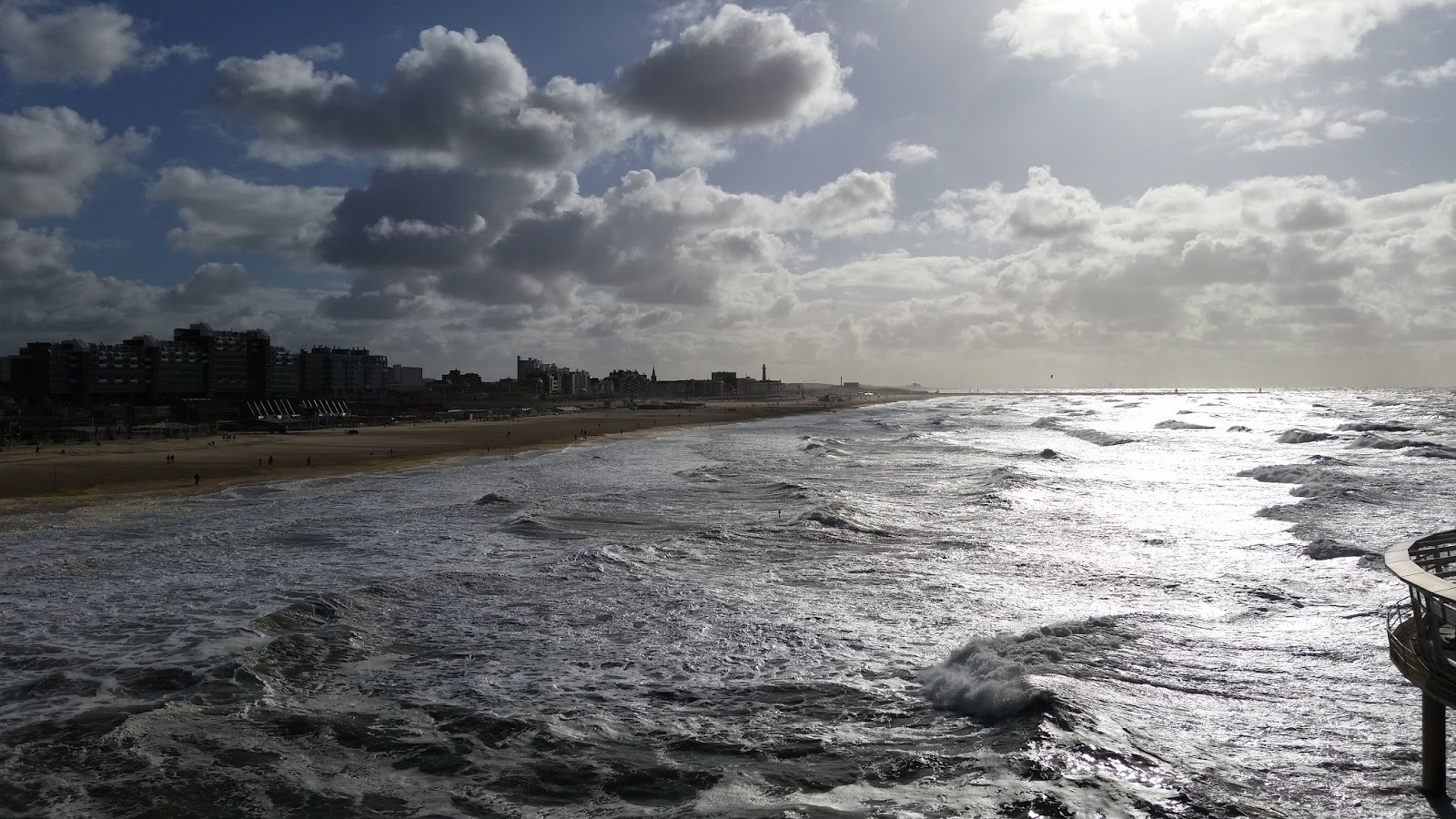
I walked back to the #1 tram and rode it to the beach at the end of the line. The scene reminded me of Coney Island.  A large boardwalk with lots of rides, there was a very big Ferris wheel at the end of a pier, tourist shops and fast and junk food places. Like Coney Island it also had high (but not as high) rise apartment buildings, but it also had several large hotels.

I walked out on the beach. Nice white, fine sand, but windy. Not too many people around and there were large waves crashing on shore. I went into the Grand Hotel. It looked a bit frayed around the edges, but it had a very large lobby with big chandeliers, but no furniture in the middle so there was a large open space. I sat down at a table, ordered a drink and began to talk with two Dutch businessmen who quizzed me about Trump and whether he was as crazy as he seemed to be. They were also concerned about whether his policies would crash the world economy.

It was about 5 when I started back. I was getting very tired, but I decided to take the #9 tram back when it came first.  I assume that it was rush hour and I was fascinated watching all the people on bicycles in many cases going faster than the tram. The #9 line ran through a tunnel under Central Station and I got out on a main shopping street in the Rabbijn Maaresenplein area. Crowded, busy and lots of upscale stores. I have come to realize that when walking I needed to look out not only for vehicles, but also trams and cyclists. Walked through that and over to the smallish Chinatown. I finally got my bearings and could get back to the hotel as it was starting to seriously rain, as opposed to the general gray and mist that was present most of the day.

After my spouse returned from her conference (she had gotten into the morning session at the Yugoslav tribunal) we went out to dinner. Intended to go to an Argentinian steak house, but her knee was acting up, so we went to a restaurant, Café Schlemmer, down the street from our hotel. A very nice setting with exposed brick walls and candles. The beer was good, but the food was just OK.  She had steak and I had a fish. Went to sleep hoping I would make it through the night.  


Monday, October 9, 2017

Oct 4, 2017 Day 3 The Hague 1

Oct 4 The Hague 1

I have a bad case of jet lag. I woke up about 3:00 am and could not get back to sleep. After a few hours of that I finally went downstairs to the empty hotel lobby. No breakfast yet, so I sucombed to an expensive candy bar. On the computer I tackled the unanswered questions regarding the Park City apprentice ski instructor offer, trying to nudge Alta on its plans and looked into renting the house in addition to reading the NY Times. Ate a leisurely breakfast while doing that. There is an extensive cold buffet at the hotel that was very good.

It took a while for me to get out of the hotel. It was cool, but not raining, so I walked over to the government complex. No available tours until the afternoon so I made a reservation and then walked over to the Prison Gate Museum, Museum de Gevangenpoort. (Dutch names are long).  10 euro entrance fee. I initially took a self guided tour of part of the former prison and then was part of a leader led tour. Unfortunately that was conducted in Dutch (understandably), but I was given a headset with an English narrative. The leader spoke English and answered my questions.

The prison was created over 500 years ago. As described, conditions for prisoners, except for VIPs or rich ones, were pretty brutal, Little and rotting food, water from a nearby polluted pond, very little light, extreme crowding and very limited toilet facilities.I imagine that was pretty standard for the time and I wonder how many survived that treatment.

As needed, confessions were extracted through torture. An impressive arrey of torture devices were on display, although not as extensive as we had seen in Lujbiana. A rack, stocks, branding irons, leg clamps and for the truly non compliant, a green gallows for hanging. (Women were garroted so no one could see up their dresses.)  It seemed credible that most accused simply pled guilty rather than be subjected to torture. however there is an interesting quirk in the Dutch system. Even after confessing, the accused must repeat  the confession on open court before a judge to ensure that the confession is "voluntary".

There was an ornaitely decorated room that held rich or VIP prisoners. they received good food, wine and visitors. Of course they had to pay for that. One of the occupants of that room in the 17th century was a de Witt brother. He was accused of treason, attempting to assacinate the ruler, one of the William's of Orange. He denied the charges and was subjected to extensive torture. Still he refused to confess. His Nathen Hale statement allegedly was, "torture will not drag out of me what is not in me", and called upon his brother, who was a high ranking official to get him out. The brother did that. However at that time Holland was involved in wars with 4 other countries that were not going welland the public was pretty mad. So when the de Witt brothers were leaving the prison, a mob lynched them.

I then went over to the ProDemos Visitors center for a tour of the Dutch Parliament complex, Binnenhof and Knightshall. 10 more euros. The Hague is the capital of Holland and in this complex we toured the Knight's Hall, the Dutch Senate and House of Representatives and the Prime Ministers office tower. Next to the complex is a small lake that freezes over in the winter and becomes an ice skating venue. The Hall building occupies the center of the complex and portions of it go back to 1250 when the Count of Holland established a small castle here next to the small town of Das Haag. He was in line to become the Emperor of the Holy Roma Empire, but he was assassinated before he could assume the post, so he missed out on a meeting with the Pope. One of the main functions of the Hall now is to host the annual King's speech to Parliament on the third Thursday of September. The monarch is driven to the event in a golden carriage. It is a large space with no columns. the roof is held up by very large curved wooden beams.

The Senate has 75 members who serve 4 year terms. They do not meet that often and they were not in session when we toured the facility. Perhaps that is why there was no security to enter. In contrast, we had to pass through airport style security to enter the House of Representatives. It was housed in a 1990 building that still looks new and modern. Lots of glass and light. 100 members also elected to a 4 year term. We were handed a color coded chart showing where the different parties sat and how many there were. The extreme right wing nationalist party has 20 seats. Several members were milling around and we witnessed a speech about EU monetary issues.

The PM's tower is a very old facility with limited room. Its office has much more space in the downtown government office buildings that make up the skyline of The Hague.

By now it was about 5:00 and I was very tired. I walked back to the hotel and promptly fell asleep. I woke up about 10 and could not easily get back to sleep. So the jet lag cycle continued.
Torture rack

Rich prisoners Room

Knight's Hall

Parliament Lake