Tuesday, May 7, 2019

Stone Town in Zanzibar Town

November 9, 2018

We began the day with a luxurious breakfast spread at the hotel. Lots of fresh tropical fruits and juices, local breads, chicken curry and a made to order omelet. We ate outside with the ocean over our shoulder, but it was already getting hot and humid. No sense complaining about the weather when you come to an ocean island near the equator, but it sure does feel sticky, especially when I was wearing my recently purchased clothes that are far less than ideal for the weather.

We left the hotel about 10 and almost immediately were approached by what became a stream of papaasi, people who wanted to guide us, tour us , drive us, or otherwise sell services. There are also the product sellers. One has to be polite in saying hapani (no), but also firm.

We walked over to Forodhani Gardens again. This time it was largely deserted, except for the many cats and the papaasi. It was pretty looking out onto the ocean and seeing the boats, from the small doaws, to the ferry, this was the Kilimanjaro VI and the large freighters.

We walked through the gardens to the Old Fort, also called the Arab Fort. At  the entrance was an office of the Zanzibar Tourist Office. After a bit of haggling about the prices we signed up for two tours the next day, a morning spice tour and an afternoon boat tour to Prison Island. $90 for both including my daughter. I put half down and the rest to be paid the next day. I wanted to use the Eco+Culture  company I had spoken with the prior day which had been recommended in the travel book, but they were quite a bit more expensive and the agent I spoke with seemed enthusiastic.

We then entered the Old Fort. It is a large structure containing large open courtyards, one of which now has been covered into an open air amphitheatre that is used for music and dance events and the Zanzibar International Film Festival.  
Amphitheatre


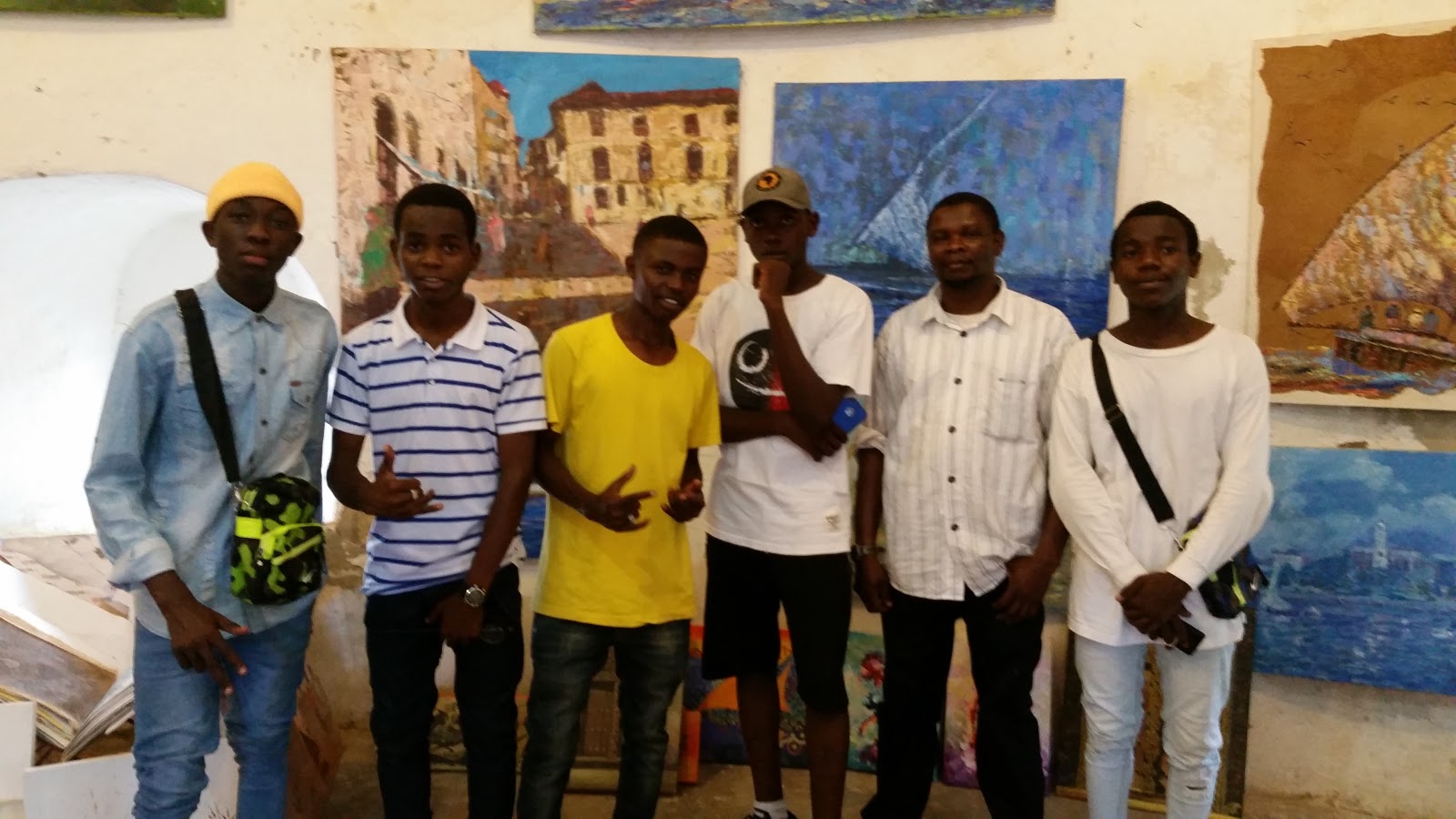
Artists

Fort courtyard

The Fort was built from 1698 to 1701 by the Omani Arabs after they had defeated the Portuguese who had ruled for 200 years. The fort was used to repulse efforts by the Portuguese to retake the island as well as attacks from a rival Arab group based in Mombasa. It was built on the site of a Portuguese church the remains of which were visible in the main courtyard.In the 19th century the fort was used as a prison with the execution site being just outside the east wall of the fort.  The Swahili word "gereza" means prison is thought to be derived from the Portuguese word igreja, meaning church. In the early 20th century it was the southern depot for a railroad that ran north to Bububu. It was rebuilt in 1949, but it fell into disuse in 1964 after the revolution.

We walked through the courtyards and on the battlements. there were several art galleries, Colors of Zanzibar and Collective Art Gallery in the towers. Despite the artists obvious willingness to bargain over prices, we did not purchase anything. There were local spice and craft shops, and a good toilet.

We left the fort after about 1.5 hours and returned to the gardens. Engaged in a conversation with 4 teen age girls. They were very animated and questioned us about the US. They are learning English in school and asked us about our trip. 
Teenage girls

We were repeatedly approached by papaasi and after much haggling with one we agreed to a walking tour. Agreed to $20 for 2 hour tour.  What followed was a leisurely stroll through the Old/Stone Town area.  He started with a history lesson about the Old Fort and the Gardens. We then walked over to the House of Wonders, Beit al Ajaib. This was a state of the art building when it was built in 1883 as a ceremonial palace for the Sultan Barghash, and remains one of the largest buildings on the island. It is a perfect rectangle, topped by a large clock tower. It was built with marble floors, steel pillars and girders, was fitted with electric lighting and had an electric elevator. Hence the name House of Wonders. It served as a palace until 1911, then as a British colonial office for 50 years and the housed government and political party (there was only one political party so co-location was convenient) offices for 30 years until it was abandoned in the 1990s. It reopened as a museum in 2002, but the roof collapsed in 2016 and so it is not currently open to the public as it undergoes repairs. In front were two Portuguese cannons from the early 16th century.

A few hundred yards up the road we visited the Palace Museum. A large white building built close to the sea in the late 1890s it was originally called the Sultan's Palace, but was renamed the People's Palace after the 1964 Revolution. It became a museum in 1994. The exhibits included a lot of furniture, clothes and art from the sultans and British colonial period. There was a gigantic banyan tree 100 meters up the road. It was planted in 1911 and is known as The Big Tree. We then walked into the interior of the city and passed or visited old hotels, galleries, small businesses, restaurants, and mosques and churches. While the art in the galleries was locally produced, some of it seemed formalistic. 

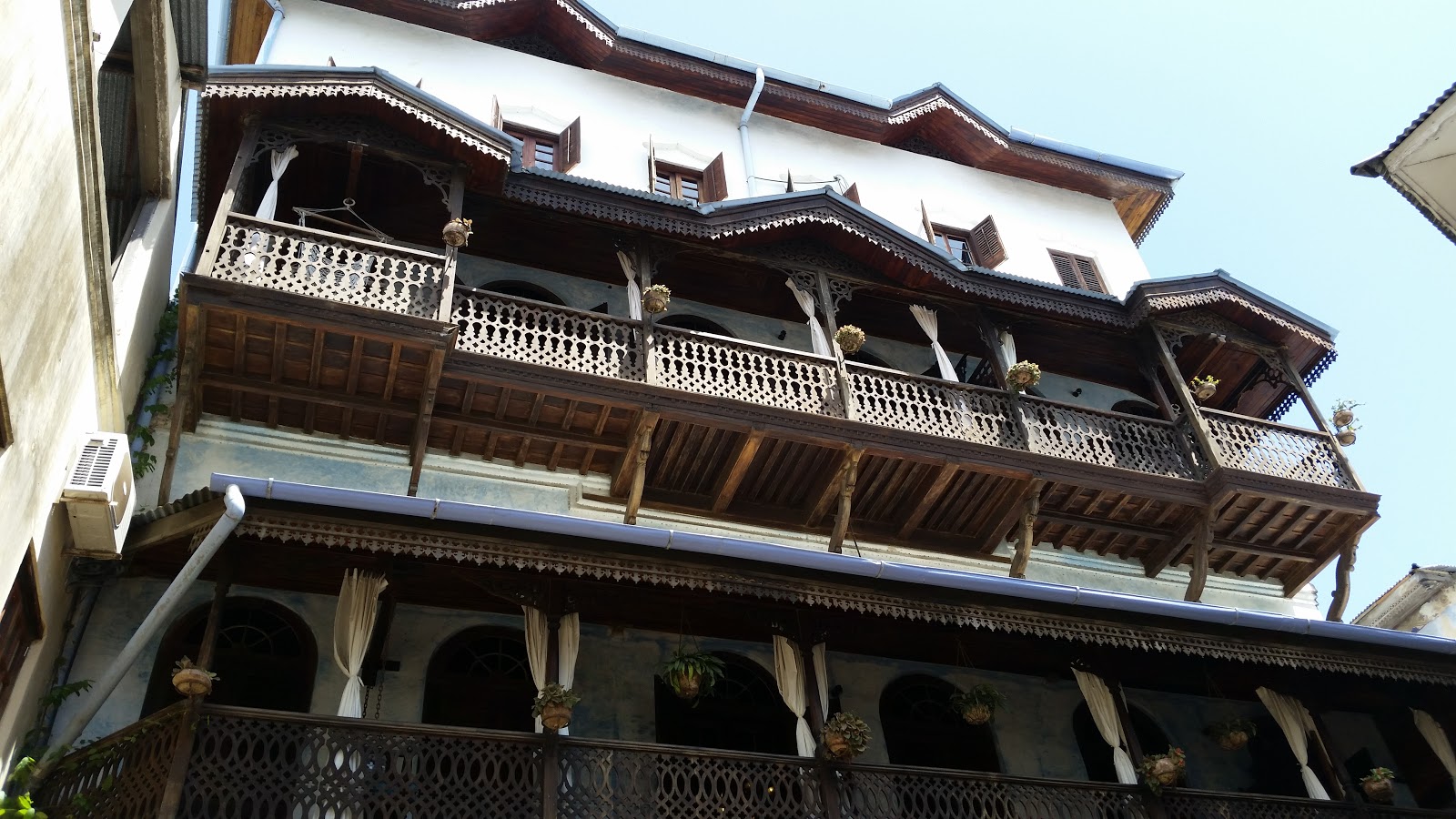
Most of the buildings we saw were built in the 19th century when Zanzibar was an important and affluent trading center. Many of the buildings were three or four stories and their stone construction consisted of locally mined coralline rock. It is a good construction material, but it is soft and easily eroded if not maintained. While virtually all of the buildings are still inhabited or used for commercial purposes, many are in a state of disrepair. However we saw some structures that were being restored to their original appearance through a UN and government program. (Reminded me of the restoration that is occurring in Old Havana.)   The buildings were predominately of two architectural styles, Arab, with plain outer walls and a large door which lead to an inner courtyard   (which we usually could not see), and Indian, with an open facade and large balconies decorated with ornate railings and balustrades designed to catch sea breezes and dispel the humidity. Very similar to what we saw in India, albeit much of that seemed to be based on the Mogul, Islam empire architecture. 


Many of the buildings had large wooden doors with elaborately carved frames and panels decorated with large brass studs, spikes and heavy locks. The studs and spikes were allegedly designed to prevent war elephant attacks. They are mostly decorative since while elephants were abundant on Zanzibar when Marco Polo passed through in the late 13th century, they were long extinct when  these structures were built in the 19th century. The greater the wealth and status of the owner, the more elaborate were the door carvings. Many of the doors had chains carved at the side which indicated that slaves were held in the house. We also saw, and sat on, many baraza benches. These are thick benches of solid stone, not very comfortable, built into the walls of the structures and also in the courtyards. They permitted Islamic men to receive visitors at or in their homes without compromising the privacy of the woman folk.
 Arab Style
 Indian style


At the Swahili House hotel we took the lift (added in 2015) to the roof top restaurant/bar for drinks and snacks on a baraza bench. Terrific 360 degree views of the Zanzibar Town, the Zanzibar Strait and the land outside of Stone Town. This was a 19th century Indian merchant's home that in 2008 was renovated into hotel. However it is not fancy and retains a local feel with a very calm environment.   

The Market at the east end of Stone Town along Creek Road  (the creek has been paved over) was built in 1904, and looks as if little has changed since then. (Viewing the photographs from the early days of the market in the market's museum confirmed that.) The market is essentially a long hall with traders inside and out selling their wares from small stalls or simply with their goods spread out on the ground. It was especially active today, since it was Friday. There were an amazing variety of goods available for purchase that included books, CDs, furniture, clothes, car parts, and even sewing machines. Of course there were also all manner of foods available. Speaking with some of the shoppers, mostly women who were very colorfully dressed it seemed as if they had come from many parts of the island.  

At the end of the Market was the seafood section. There were active auctions going on to sell batches of seafood and lots of filleting of the fish. Pretty big smells and lots of flys. 

I purchased more spices.

On the way back to the hotel we walked past the East African Slave exhibit. Did not go in at this time since we had used up our two hours. 

After the tour we visited several galleries and finally picked out three paintings. As usual there was a lot of bargaining and because the owner wanted cash I had an actual limit on my spending. We walked out with a very large cardboard tube as I wondered if I would be able to get that on our future flights and if so, without any damage to the paintings.

After shopping we returned to the roof top of the Swahili House to meet our daughter who was joining us for the weekend on Zanzibar . More  views, sun downers and snacks


and then we walked through town to the Monsoon restaurant. This serves Mediterranean and Zanzabari food. You doff your shoes upon entering and sit on rugs and cushions, I needed a lot of the latter, and essentially sit on the floor, Kasbah style. There was live taarab music and after dinner we spoke with the musicians for a while. The food was good and the price was a great value. However after dinner I had to return to the back machine for another infusion of local cash.

At the hotel we had some dessert on the beach side patio followed by an evening swim in the pool

Overall Stone town is a very vibrant and charming place. Unlike Dubrovnik, from which most of the residents have moved and is essentially now a giant outdoor museum, Stone town is a living community where the residents live, work and play, along with the many tourists. 


Tuesday, April 30, 2019

Trip to Zanzibar


November 8, 2018 Thursday

The Trip

We got up early and by way of an Uber called by my daughter we traveled to the ferry terminal in downtown Dar. It was very congested riding out of the peninsula where my daughter lives, particularly at the Selander Bridge, but we had allowed enough time for our 9:30 am ferry departure. Traveling to Zanzibar seemed to be like traveling to another country. Several times during the ferry boarding process we had to produce our passports, more often than we had to produce our ferry tickets. The fare was about $30 for first class tickets, locals need only pay $12. We were counseled that the 2 hour ride could be rough with lots of vomiting by the masses in economy and that conditions would be more tolerable in first class.

We waited in the first class lounge for about 30 minutes and then boarded into the first class area. Nice seats and not crowded. The ride on the Kilimanjaro V ferry boat was uneventful. Nice, smooth ride across the Zanzibar Channel. We arrived at about 11:30 and had walking directions to the hotel, but it was hot, the bags were heavy and I was disoriented and not sure where to go, so we took a cab. $3.50. The driver took the long way around and we got to see a bit of Stone Town's boundaries, but the walk would have been doable if I had known where to go.

Business class on the ferry

Dar es Salaam skyline


From the guide, museums and the tourist book I learned:

History

The Zanzibar archipelago has a long history that differentiates it from the rest of east Africa. It is made up of two main islands, Pemba (we did not go there) and Unguja. Due to its location and the Monsoon winds that blow across the Indian Ocean, early on Zanzibar served as a trading crossroads for goods and people from Persia, Arabia, India, and even goods from China in the east, and from the west, the Greeks, Romans, Egyptians and Phoenicians. The Arab traders called the islands Zinj el Barr, meaning land of the black people.

In the 7th century Arabs started migrating to Zanzibar in larger numbers and brought Islam with them which was adopted by some of the locals. One of the stories in the 9th century The Arabian Nights, Sinbad the Sailor is based on a voyage to  East Africa by Arabs. Trade between the locals and the Arabs/Asians exported ivory, rhino horn, tortoiseshell, palm oil and African slaves. and imported metal tools, weapons, Indian cloth, Chinese porcelain, wheat and wine.  Much of it was carried out in Swahili dhows, based on Arabic design. To facilitate these contacts a new language developed, Swahili, which came from the Arab word sahil, meaning coast. It incorporated the local Bantu language, as well as Arab and Persian words.

By the mid 15th century trade had greatly expanded, even though around that time after a giraffe had been delivered to the Emperor of China, the successor emperor banned Chinese merchants from going abroad, and the chain of Swahili Islamic city states along the east Africa coast were thriving.
Then came Prince Henry, "the Navigator", looking for a sea route to the east as well as the legendary Christian kingdom of Abyssinia (present day Ethiopia). Subsequent Portuguese expeditions followed and by 1503 the Portuguese had conquered Zanzibar, although they permitted the local ruler, the Mwinyi to remain in place as a figurehead to whom the local population continued to pay allegiance.

The Portuguese remained in control for almost two centuries, until the Omani Arabs drove them out in 1698. However their legacy remains in the many Swahili words with a Portuguese origin.

The Omanis had large date plantations in Oman that were very labor intensive. Islam prohibited the enslavement of other Muslims, so the Omanis turned to Africa for slaves. Many of these were transported through Zanzibar. The market for slaves was seemingly inexhaustible since the Omanis did not permit their slaves to have children and many of the slaves were worked to death. By the end of the 18th century the demand for slaves was so great that Arab and Swahili slave traders were penetrating the African interior and bringing large caravans of slaves to Zanzibar for transshipment to Arabia, Reunion Island and the Dutch East Indies.

However by the early 19th century slavery and/or the slave trade was banned in most of western Europe and the US. The slave surplus was addressed by importing Clove trees from Reunion Island to Pemba and some of the slaves were diverted to work on the clove plantations. Trade in high priced cloves  increased Zanzibar's wealth and strength. Reflecting this, in 1840 the Oman Sultan moved his capital from Muscat, Oman to Zanzibar City which prospered and developed. During this period the British were putting increasing pressure on the Sultans to restrict and ultimately abolish slavery and the slave trade and by 1889 the British forced Zanzibar to do this.  With the source of much of its wealth gone, during the European scramble for Africa in the late 19th century, Zanzibar became a British protectorate.

Zanzibar became independent in 1963, but in 1964, following a revolution that resulted in the massacre of more than 17,000 Arabs and Indians, Zanzibar joined with newly independent Tanganyika to form Tanzania. After the revolution virtually all the remaining Asians and Europeans left Zanzibar. To replace them Zanzibar sought assistance from Cuba, China and East Germany. The architecture outside of Stone town has blocks of Stalinist brutal buildings and there are pockets of that in Dar.

Today Zanzibar still has a special status in Tanzania. Unlike the other states it has a President and Vice President, it requires passports upon entrance and it is overwhelmingly Muslim.


Hotel

We are staying in a very nice place, Tambo House Hotel. This turned out to be a great location on Shanghai Rd. just west of the Forodhani Gardens and with a patio leading right down to the beach. The dining area overlooks the ocean and its tables are under almond trees. The room décor is Indian, there are lots of Arabesque arches and plants and the bathroom has a Turkish mosaic tile bath. The building was built in 1834 and served as the American consulate for many years.  Two subsequent additions form a courtyard around a large pool. The word tembo means elephant in Swahili and the hotel sports a grey elephant sculpture at its entrance.  Across the road is the Freddy Mercury House, the star of the recently seen Hungarian Rhapsody movie, who was born in Zanzibar.

View from our hotel room
Hotel bedroom


Touring

After settling into the hotel we walked over to the Stone House Cafe. It was a short walk on Kenyatta St, which has lots of shops and street vendors. This is an Aussie-Zanzibarian run cafe. We ate outside under an oasis of lush palm trees and umbrellas. The fresh fruit smoothie was good.

We then walked down Gizenga Street, a main shopping thoroughfare. All these streets are very narrow, more accurately characterized as alleys, and lined with stone buildings. We stopped in several shops and purchased a small painting and some spices. Lots of bargaining. There are lots of galleries and other touristy type shops, as well as restaurants and small hotels.
Stone town street


As we continued to walk along and through the tangle of alleys we stumbled upon the Eco+Culture tour center. The tourist book highly recommended them. I had a nice discussion with the agent, but the prices were high. They we went into the Princess Salme Museum. This is a fascinating place. It is a small place housed within the Emerson on Hurumzi hotel.

This museum was created and curated solely by a delightful man, Said El-Gheithy. He served as our guide through the museum. ($10 entrance fee and $10 additional for his guidance.) He has developed and cared for the museum out of devotion to Princess Salme. It is a homage to the Princess, told through photographs, story boards, family trees and artifacts, and the adoring explanations of our guide.  The Princess had quite a life. She was the daughter of Sultan Said and his Russian "secondary" wife. She received an education in womanly arts: sewing, embroidery, etc, but she was rebellious and taught herself to read and write. She had a very royal upbringing. Slaves attended to her all day, they ran beside her when she was riding carrying a parasol to protect her from the sun, and throughout the night when she was massaged to sleep and fanned during her sleep.

As a teenager she sided with one of her brothers when he unsuccessfully attempted to overthrow an older. brother. She helped the younger brother escape and although was not physically punished , she was ostracized by many others in her family. Perhaps as a result she began to socialize secretly with foreigners and at age 22 she became pregnant by a German merchant. In the words of  Said El-Gheithy she "left for Germany without saying good-bye".  At a stop in Aden she renounced Islam and converted to the Anglican Church, where she also married. In Germany she had three children, but her husband died in 1871 in a trolley accident. She was not welcome in Zanzibar and her efforts at reconciliation with her family were unsuccessful. She died in Germany in 1924. Among the possessions found after her death was a bag of sand from a Zanzibar beach that we saw at the museum.
.
On the way back we got out of the maze of streets and walked toward the seashore. It became apparent how ridiculously close the ferry terminal is to our hotel. We walked along the shore into the Forodhani Gardens. This is between the Old Fort and the sea, overlooked by the House of Wonders. This was the site of the customs house and import offices for many years which are shown on old pictures of the site. Indeed Forodhani means "customs". The gardens were laid out in 1936 to commemorate the Silver Jubilee of Sultan Khalifa and were known as Jubilee Gardens until the Revolution in 1964.  It was renovated in 2009 and now is a very inviting open space. I liked the dhow-shaped adventure playground. There were several sites where people were diving into the ocean.However the highlight was the Night Food Market. It was just getting started as we passed through. There were many food stalls, many of which had chef hatted vendors who were preparing grilled seafood and Zanzibar pizza, seemed to be a filled pancake. Prices were reasonable and we ate off paper plates. 

On the walk back to the hotel we changed some money and after a swim in the pool we finished the day and into the evening with some snacks and drinks on the patio overlooking the sea while watching the passing boats and ferries.  
Sunset swim

Sunset at the beach

Evening at hotel


Monday, April 29, 2019

France to Tanzania

November 6 and 7th, 2018

Harrowing Travel.

Time to leave France and begin our trip to Africa to visit two children on that continent.

I have never been to Africa and I was both curious and a bit apprehensive about going there. I have been to developing countries before and have been to places where I was a minority, plus I have two children living there without incident, so there was no objective reason for my concerns. I know it is utterly romantic, but, hearkening back to my high school readings, I feel  a bit like Marlow in Heart of Darkness (a Joseph Conrad novel) preparing to go into a mysterious (at least to me) and uncharted space.

So much for feelings. We had to get up early, 6:00 am, to be driven, by our son-in-law to the Amboise train station to catch an early train to get us to the Paris airport early enough for an international flight.  We arrived at the station in plenty of time, but noticed as we entered the station a lot of people milling around. The electronic train information board showed a lot of delayed trains. It was hard to get information, but we finally were told that there was something wrong with the infrastructure at the station and trains were not stopping there. Needing to get to the airport, we tried to rent a car. There were almost a dozen rental car companies at the station, but until we got to the last one, none had cars available. An expensive one way rental, but we had to get there, so we took off on to the very expensive French tollways. Then we had to fill up the tank with expensive French gasoline. It took a lot of work by the son-in-law to get a refund from the railway.

We arrived at the airport later than the train would have gotten us there, but still with plenty of time. I subsequently learned that I had received a speeding ticket during that drive. I did not think I was speeding and many cars passed me along the way. It seems as if I always get a speeding ticket every time I drive in France.

We are flying on Egypt Air to Tanzania via Cairo. The reviews of the airline were OK and so I picked that airline rather than selecting what I thought might be more reputable airlines, Turkish or Qatar, because they had more circuitous routes, via Istanbul or Doha, that took longer.

The flight to Cairo was uneventful, food and in-flight service was fine, and we arrived on schedule. The interior of the Cairo airport was pretty good, better than LaGuardia, but not as nice as Doha, and large. I misread the time of our connecting flight and while we were looking for an airport lounge to decamp into, we discovered that we better get to our gate for the flight to Dar es Salaam. I was also confused about our arrival time in Dar given the time zone change and the change in the departure time.

It was strange being on a flight where most of the passengers did not look like me, dress like me or speak like me, but again the flight and service were uneventful. We arrived in Dar about 4:00 am local time. I think we have been up and traveling for about 24 hours. We passed through Immigration fairly easily after paying $100 in dollars for our visa, but I then was faced with the fact that my luggage had not arrived. It was a laborious process filling out the claim forms in longhand with a person who was not an employee of Egypt Air.

After the lengthy process we met Frank, the driver who our daughter had arranged to pick us up and deliver us to our daughter's apartment. Fare was $25 in dollars. As we drove from the airport into Dar in the early morning sunlight we saw Dar begin to wake up. Many pedestrians, even more people cramming the buses on their way to their daily activities. The city has an impressive skyline and a beckoning harbor. Lots of trash and not too much greenery. Even at that early hour the traffic was beginning to build and as we made our way through the downtown area to go to our daughter's neighborhood in northern Dar, the incoming traffic, particularly approaching the Selander Bridge was approaching a standstill. After the bridge we drove along the bay for a brief time and took in a glimpse of nice beaches.

Our daughter lives in a luxurious, (not by NYC standards) high rise, gated, apartment complex. She is there through a friendship with a European diplomat. With a balcony, pool and expansive views of the bay it was not something that she could have afforded by herself on her NGO salary. I had not seen our daughter for 15 months since she had left for Africa so we had a joyous greeting. She went off to work and we had some breakfast, unpacked (no need for me to do that) and then took a nap in a room that had been temporarily vacated by a diplomat who was on extended travel.

Our daughter picked us up at the apartment in mid afternoon. She made some calls about the luggage and learned that the luggage had not been located, but that Egypt Air flew into Dar only twice a week so even as they located my luggage, the earliest it would arrive would be on Sunday. We walked over to the site of her Swahili language teacher. With her working at a local organization and the language lessons she has become pretty fluent in Swahili. We took a one hour lesson and picked up some basic phrases. I left with a cheat sheet.  Next we went to a street vendor our daughter knew so I could get some clothes. After much bargaining and searching through piles of clothes I left with two European club soccer jerseys, orange track pants, a bathing suit and a pair of shorts, all used, for $15 (our daughter would not let me bargain hard) and all seemingly from western countries.  (I recall that when we were in Haiti I saw the same phenomena, lots of athletic branded western clothing, even some with championships that were not attained.) We then walked over to a harbor front restaurant at the Best Western Hotel where we drank "sundowners", a common activity among the affluent.

 Beautiful sunset over the bay.
We took a "taxi", a three wheeled "brajyi" out of there. We finished the evening with dinner at a local restaurant, Jackies. There was a power failure so we ate outside from a limited menu, but the meal, conversation and local beer were all good.  

Domestic Activities

October 29 - November 6, 2018

We are staying at the country house of our daughter, granddaughters and husband. They kids are on school holiday, so the main purpose of this part of the trip is visiting, along with shopping, cooking and eating.

1. Monday - The main activity for the day was food shopping. We went to a large, upscale Walmart type store and then went to several specialty stores, butcher, bakery, cheese store etc. Spent over 400 euros. Aside from interacting with the relatives, there is not much to do out here. We are in the country, about 15 km away from Amboise. There is no mass transit and we are without a car since I crashed and totaled  the Twingo back in 2016. The Internet connection is at best spotty and television and radio are, understandably, largely in French. So with the assistance of the youngest grandchild, we made cookies. They were hard to cook because the stove at the house is not functioning well, but they were eaten quickly.
  Every time I come to the daughter's house I run. I purchased running shoes in Ljubljana in 2015 (much more expensive than in the US) and have left them in the guest house here ever since. They were always a bit tight, hard to convert to European sizes, but that never caused a problem. I learned that our daughter had been using them and now they were very tight at the right toe, but I ran in them anyway. I always run here, regardless of the season, because I enjoy being out on the county roads, running past the wine vineyards, through the forest, the air is very clear, and probably because I have little else to do. Unlike other places, and even though I have usually not run before these visits, I do not have any hesitancy about running here. I usually start out running about 2 miles and work my way up, depending upon the length of the visit to 5 or 6 miles. So today began the usual running regime.
  On another note, another grandson was born today.
2. Tuesday -  Our daughter's Irish friend/employer is, along with her French husband, a bit of an entrepreneur owning a vineyard, winery, restaurant and wine shop. She and an American artist had cooked up a plan to display the artist's pictures in the restaurant and on wine bottles, coupled with the purchase of some pictures. The friend presented us with a proposed contract to memorialize these arrangements. That contract had allegedly been drafted by an American friend of the artist. It was very disjointed and failed to account for detailed French law on the subject of the rights of artists.This was a great task, it gave me something to do. We had lunch with the artist and friend at a wonderful bistro in the country. It was a lovely lunch.
  We then went to the chateau where the artist is staying. It is a magnificent complex that is owned by an American couple who live in the Bay area and are patrons of this artist.
  Our final stop was at the complex where our oldest son will house guests for his wedding celebration in June. It seems very nice, an old hotel with nice grounds and views. Not within walking distance of the town where many of the guests will be staying.
 Ran little further in the evening. Great sunsets in the countryside at this time of year.
3. Wednesday - Slow day. Ran in the morning and then began research on the contract. In the evening we went to a Halloween party and dinner at the home of our daughter's brother-in-law. They have a very nice house and grounds.
4. Thursday - Another slow day.Went for tea at the opulent home and winery of our daughter's friend. All woman except for me and lots of french spoken. Good tea, but I was pretty bored. Ran 3 miles in the afternoon but toe was feeling squeezed. In the late afternoon I made banana bread with the middle granddaughter. That was eaten quickly.
5. Friday - The daughter and the grandchildren drove with us to Tours to see the movie Bohemian Rhapsody. The theatre showed the film in English. A fun movie even though while I was not that familiar with the group Queen, I did recall their music. In the evening we went to a group our daughter has organized for English speaking expats who live in the Loire Valley. They meet monthly in a bar/restaurant, Le Shaker, on an island in the Loire River. We have attended this group in the past and have met some of the attendees. A pleasant evening.
6. Saturday - Ran 4 miles in the morning. Feeling stronger, but toe is definitely uncomfortable. Probably doing damage, but I enjoy the running. We went to Tours again, this time for appliance shopping. The stove in our daughter's kitchen barely worked, it required all sorts of manipulations and gimmicks to turn and keep the stove burners on and the oven door shut. They did not have the resources to replace it. So we purchased a new stove/oven, freezer and other appliances for them at a warehouse appliance type store. Kids remain kids.
7. Sunday - Ran 5 miles into the woods in the morning. We went out to dinner out in Tours at an American style diner, burgers and shakes type fare.
8. Monday - In the morning we went to the friend's house again to offer our suggestions to modify the proposed contract with the artist. We proposed substantial revisions based on French law and she was amenable to them. Subsequently learned that the proposed arrangement fell apart.
 We packed for our departure on the following day. I put several cold weather items, a good vest, hat and gloves,  separately into a bag, probably because I wanted to keep them outside the airline weight limit. Somehow they got lost during the trip and  I have never seen them again.

 Luncheon bistro
 Gatehouse at chateau
 Son's wedding clebration site
 Halloween party
 Sunset at daughter's house
 Friend's house
Sunset in French countryside

Friday, November 9, 2018

Out of Paris

October 28, 2018 Day 6

I was surprised by the time change, a weekend earlier than in the US. Fall back, so we gained an hour and rather than being late we were early for the brunch at the house where the daughter and grandchildren were staying. Friends of the daughter had done a home exchange for this house in Paris and that is where the daughter and granddaughters were staying. It is in an neighborhood of Paris which has very few single family homes and the estimated value is about 4 million euros. Nicely done, but a very small kitchen and three medium sized bedrooms. But it has a circular dining room, two balconies and a finished basement which I was told is the grandparents suite. The owners are a French American couple with two kids. As seems to be common in my anecdotal experiences, in most of these relationships the woman is the immigrant.

It was a lengthy brunch attended mainly by acquaintances of the friend of the daughter. One couple was a French diplomat serving a domestic posting on the West African desk. Her trailing American husband said it was difficult finding a position as his experience was that even when he was well qualified for a job, the firms definitely preferred to hire French. They have a nice little kid.

I took a nap in the mid afternoon and then we walked back to the hotel to pick up our luggage. Took a cab to the train station, Gard Austerlitz. The cabbie did a very good job weaving through crowded Paris traffic to get us to the train station on time. We had to walk the entire length of a 16 car train to get to our assigned coach where we again met the daughter and granddaughters.  It was the "slow" (not the TGV) train for our trip to Amboise. We changed trains in Orleans and arrived in Amboise in the rain and dark.  Drove our to the country house for a welcome dinner and then sleep in the bungalow.

Sunday, November 4, 2018

Museum of Immigration

Saturday October 27, 2018 Day 5

We ate breakfast at the hotel. It was a very nice and extensive buffet. Good hot chocolate, but no bagels. Expensive, but good enough to keep us going into the afternoon. We arrived when there was only one other diner, but when we left it was full.

We took off for western Paris on the Metro.  One transfer and a 25 minute ride. I had read an article in the International NY Times by a writer who walked around the exterior of Paris. One of his recommendations was the Museum of Immigration. Off the beaten path and not crowded. Walking from the Metro exit to the museum we saw a much different Paris that in the downtown area. Less affluent, fewer tourists and not as many restaurants. Plus there was a street level light rail line that is not mentioned in the guidebooks.

The building that houses the museum was build in 1931 as part of an exposition celebrating the French empire. Overshadowed perhaps by the British empire, the French empire was also extensive with large holdings in West and North Africa and Southeast Asia, as well as lesser outposts in the Middle East and the West Indies. The exposition, seemingly similar to a world's fair, had exhibits from most of the parts of the empire, (I did not see anything from Syria or Lebanon) as well as several countries, including the US.  However, along with a large sculpture across the street, the art deco exhibition hall was the only permanent structure. The exposition seemed to celebrate France's role as a protector and civilizer of the colonies while at the same time taking for granted the colonies' contribution to French wealth and culture. It was almost as if the latter was treated as an entitlement, provided in exchange for former. I got a hint of that in some of the historical museums I visited in the Netherlands last year and I imagine similar  feelings about colonialism existed in Great Britain, Portugal, Spain etc.

The entry fee for the museum is 6 euro. (nowhere in France have I found discounts for seniors.) There is an aquarium in the building's basement but we chose not to go there or pay the separate entrance fee.

The building has gone through several changes in use since the exposition and has been dedicated to its present use since 2007. Virtually all of the art from the now former colonies has been transferred to the Musee Du Quai Branly (we visited that a few years ago). This museum is more of a historical record of the building, the exposition, immigration to France and the impact of immigration on France. Although I had a very general awareness that France, particularly since its Revolution had been a haven for political refugees and dissidents, I had no knowledge that for centuries it had taken in large numbers of immigrants, in recent decades sometimes exceeding over 3 million a year. That at times has exceeded the number of immigrants absorbed by the US and represents by far a greater percentage of the population. The mix of immigrants has changed from eastern European, to southeast Asia, (Ho Chi Minh was educated and lived in Paris in the 1920s.) to north African and now increasingly sub Saharan Africa. That is evident from the faces that one sees in Paris, particularly in the many service and hospitality jobs. We witnessed a performance art performance on the main floor from an upper floor.

After several hours we departed. We took the Metro, again one transfer, to meet the granddaughters  (minus one who opted for a friend) and daughter, as well as a step grandson on the Champs Elysees. The former were coming from a hop-on hop-off bus tour and the latter from work. All were late as we waited outside the designated restaurant, really a pricey pastry shop. When we finally connected we went up the street to Le Drugstore for coffee and hot chocolate. It seems so frivolous paying very high prices for these drinks just so you can sit in a fancy place on a fancy street, but I imagine it is what many tourists do.

With the granddaughters we went to a movie on the Champs Elysees and saw A Star is Born in English. Apparently many movies are shown in France in English without subtitles. Better than I expected and two very good performances. Then we walked for a bit and had dinner at an Italian restaurant. We then dropped the girls off at the house and walked back to our hotel.

Outside the Museum


Thursday, November 1, 2018

Musee d Orsay

October 26, 2018 Day 4

The grandkids were off to the Comi Con convention so we went to the Musee d Orsay. This is a top site in Paris that I have never been to. We took the Metro. There was one transfer that required a very long walk underground.

Exiting the Metro we ate at a small sandwich shop near the Seine. Good sandwich and moderate prices.

We did not purchase tickets online as recommended, so we waited for tickets in a long line  that moved very quickly. 12 euro entrance fee. Then we waited to pass through security. Understandably, security is very extensive at all these attractions in France.

The museum is housed in a former railway station, Gare d Orsay, that was built in 1900 for a World's Fair and also housed a luxury hotel and grand reception room. It was taken out of service in 1977 and reopened as a museum in 1986. It is a beautiful building.

The museum houses France's national collection paintings from the impressionist, postimpressionist and art-nouveau movements from the 2d republic, 1848, to the start of WWI, 1914.

There is a lot of art in this museum. We focused on an exhibit that was curated by Julius Schnabel, an American artist/filmmaker, who was matching up his works with works from the museum's collection "to create a conversation across space and time." It worked better than I anticipated. The self portrait of Van Gogh stood alone. We also toured several furniture exhibits, but did not see anything that inspired us for our ongoing renovation in SLC.   There was also lots of sculpture. I got tired and we missed a lot.

After a few hours we exhibited the museum.  In the small square outside the museum there was a street band playing. It was pretty good and soon after it began playing an older woman began to slowly dance in front. I could not tell if she was just a bystander who was inspired by the music or connected to the band. I had a vision that she was the mother of one of the musicians.

We then went to into the Legion of Honor Museum on the opposite side of the square. Lots of metals, weapons and uniforms there, but not much of interest. We left after a brief visit and returned to the hotel by Metro. My spouse stopped off at a patisserie while I went back to the room for an afternoon nap. She felt that she was mistreated there by staff and customers, so she ate my pastry.

We then walked over to the house through a big rainstorm (Practice for Tanzania.) where the kids are staying. The daughter is going out with friends so we are babysitting the grand kids. We made personal pizzas for dinner and watched a superheroes movie. Batman and Superman got together and with the help of some other superheroes defeated a10 ft. tall villain who was seeking to destroy earth, or at least the city, by joining together three cubes. I was not paying close attention, but I did notice that the villain had lots of flying assistants who looked a lot like the characters in the Wizard of Oz. We stayed late after the host returned drinking wine into the a.m. hours. More messed up sleep after we walked back to the hotel through the empty, wet streets of Paris. I imagined that I was in a Woody Allen movie, but a car did not pull up to take us on a time travel adventure.
Van Gogh self portrait

 Metro sign entrance
 Museum d Orsay
Dancing lady