Sunday, June 2, 2019

Cody to Thermopolois Day 6

May 24, 2019 Friday Day 6

We awoke late. I purchased on-line tickets for the Buffalo Bill Center of the Old West. The Museum was a short drive out of town and housed in an attractive building. It had a charging station in the back lot, but the charging rate was .08 cents per minute, which is the highest I have ever seen and more expensive than gasoline, and since I had 37 miles of charge from the overnight charging at the hotel, I passed.

The museum was terrific. It had 5 different sections. We started in the wildlife and geological area which interprets the Greater Yellowstone ecosystem and wound its way down into the basement. At 1:00 we went to a raptor exhibit in which they brought out two large birds, a Golden Eagle and a Turkey Vulture.
Golden Eagle. Bigger and swifter than the Bald Eagle

Turkey Vulture. Defends itself by throwing up on a predator


We had lunch at the museum cafe, $20 for soup and salad, and then went to the William Cody a/k/a Buffalo Bill exhibit. He led a remarkable life public and private life. Orphaned at age 11, he worked as a cowboy and Pony Express rider. Moving on to soldier, to explorer, to US Army scout to performer to finally international entertainer and producer, he apparently became one of the most well known men in the western world. For 30 years he performed and then produced, while also performing in the Wild West show that was seen all over the US (every state except Nevada) and three tours of Europe. He even performed for Queen Victoria of England at Buckingham Palace. He earned his nickname by shooting 4280 bison in a span of 18 months to provide food for construction workers on the Kansas Pacific Railroad. The gun wing was closed, but we ran out of time after touring the western art exhibit. Lots of works by Fredrick Remington.


On the way out of town in the late afternoon we gassed up for the 1.5 hour drive to Thermopolis through empty, (listened to Sirius Radio) but scenic landscape.

We checked into checked in at the Fountain of Youth motel in Thermopolis. Not much positive to say about the motel, except that it had a good bed and an external outlet to charge the car.

We walked around town and ate dinner at the One Eyed Buffalo. Brewery pub. Very loud, but the food was good.

Mud Pots and Buffalos Yellowstone 4 Day 5

May 23, 2019 Thursday Day 5

When we woke up we experienced our first sunny day in Yellowstone. I thought that it might even be relatively warm and after eating breakfast again in the cabin from the cooler I ventured outside without multiple layers. I needed to go back in and put on my vest.

After packing up and checking out we back tracked and drove a few miles to Midway Basin. Midway Geyser Basin contains a small collection of mammoth-sized springs. Midway is part of the Lower Geyser Basin, but because of its isolated location between the main features of Lower and Upper geyser basins it became known as Midway. Rudyard Kipling, who visited Yellowstone in 1889, immortalized this basin by referring to it as "Hell's Half Acre." It warrants that name. Despite its small size Midway possesses two of the largest hot springs in the world. 

Grand Prismatic Spring, nearly 370 feet in diameter, sits upon a large mound surrounded by small step-like terraces. Grand Prismatic is the largest hot spring in Yellowstone, and is considered to be the third largest in the world- New Zealand has the two largest springs. Grand Prismatic sits upon a wide spreading mound where water flows evenly on all sides forming a series of small, step-like terraces. The artist Thomas Moran who traveled out here in 1871 made water-color sketches depicting the rainbow like colors and the wide distribution of his paintings helped to make Yellowstone a National Park. The colors begin with a deep blue center followed by pale green. Green, slippery algae forms beyond the shallow edge. Outside the scalloped rim a band of yellow fades into orange. Red then marks the outer border. Steam shrouded portions of the spring, but aerial pictures when it is clear are spectacular. It releases 560 gallons of hot water into the Firehole River per minute. the combination of the river and hot springs waters creates a designated swimming area where the water temperature is about 80 degrees. No one was swimming.


The other feature, Excelsior Geyser, erupted nearly 300 feet high before the 1900s. It is now a dormant geyser and is considered a hot spring, discharging more than 4050 gallons of boiling water per minute. Other colorful springs include Turquoise and Indigo springs, known for their pale and dark blue colors. Across the Firehole River from Excelsior and Grand Prismatic springs are a series of small isolated, pristine springs and mud pots. The Rabbit Creek drainage possesses some colorful and unusual features and most are unnamed.

We then drove south and turned east over Craig Pass crossing the continental divide twice.

We pulled into the West Thumb Geyser Basin on the west side of Yellowstone Lake. It was very cold. This small basin has a collection of all four geothermal features, geysers, mud pots, hot springs and fumaroles. It has an excellent boardwalk system that takes you right along the lake which was largely frozen, but which had circles of ice free water where hot springs or geysers were bubbling up. The wind blowing off the lake was bitterly cold. Yellowstone lake is the largest freshwater lake in North America above 7000 ft. As recounted in the Lake Yellowstone hotel which was built in 1891 and recently restored, early visitors to the park in the summer would catch cutthroat trout in the lake and then swing them on their line over the hot spring for cooking. The hotel's deck overlooked the lake, but it was too cold to sit out there.

Yellowstone Lake near the center of the Yellowstone Caldera which was created by a gigantic eruption 640,000 years ago. The Caldera covers most of the Park and the magma under it creates geological bulges, or domes which push up the surface of the earth. The Sour Creek Dome on the far side of the lake is rising at a rate of 1.5 inches per year causing the Lake to tip southward.

As we walked the boardwalk we saw: the Abyss Pool which was very deep and many colored; the Black Pool which is no longer black due to the death of the black colored thermophile; the Big Cone and Fishing cone which both sprouted and bubbled in the lake and the Thumb Paint Pots with their miniature reddish mud volcanoes.
Yellowstone Lake with Sour Creek Dome in the background


Intending to continue heading east to exit the Park, instead I missed a turn at Fishing Bridge and was headed north  through Hadyon Valley and to Mud Volcano. In the former we saw many wildlife, and also experienced much delay as cars just stopped on the road to observe. In the latter we saw a large buffalo herd and walked on a loop among many thermal features. Dragon Mouth Spring has steam belching from a cave. Very noisy. The Mud Volcano has a seething, bubbling mass of mud emerging from a back wall. Black Dragon's Caldron has multiple geysers and is fed by Sour Lake, which looks as if you can have a pleasant swim there but whose water would burn ones skin like battery acid.   Mud Geyser has lots of mud pots and sizzling features which have killed the vegetation around it while Mud Caldron has cooled off to the degree that the bubbling is caused by escaping gasses

Finishing with the Mud Volcano I mistakenly continued north until I saw signs for the Upper and Lower Falls of the Grand Canyon and realized where I was. I then turned around, made the correct turn to Fishing Bridge and took the very scenic drive to the Park's east entrance. The extra driving finished off the electrical power in the car. Back to gasoline.

As we exited the Park the land became far less mountainous and we began to see ranches, both real and dude, and farms.

We finally arrived in Cody. This town was the brainchild of Buffalo Bill Cody and we stayed in The Irma hotel he built in 1902 and named for his youngest daughter. Cody is small, less than 10,000 population, but during the summer season, we missed it, there are nightly rodeos and gunfights as it attempts to recreate the wild west.
Cherrywood Bar at the Irma Hotel

Downtown Cody
We checked into the hotel, changed rooms due to unmade beds and walked around town. Everything looks western from the boots to the fringe. We ate dinner at the hotel and had too much prime rib. I was able to charge up the car outside the hotel at the outlets used in the winter for engine heaters

Saturday, June 1, 2019


May 22, 2019 Day 4

Four and a Half Old Faithfuls – Yellowstone 3

Woke up this morning to again find the car and the roofs covered with snow. We had breakfast in the cabin. From the cooler, yogurt, blueberries, tomatoes and an orange.

We walked over to the Visitor Center, a relatively new $27 million building and on the way mailed a letter at the Yellowstone Post Office and stopped for some coffee at the cafeteria. The next Old Faithful explosion was not for 20 minutes, so we watched a movie in the education center and briefly viewed the exhibits. It was not nearly as good as the movies I have seen in other National Park Visitor centers. This one devoted a lot of time to safety, staying on the boardwalks to avoid getting burned alive or eaten by acid. One should not need a movie to warn you not to stick your hands or feet into boiling water. Not too much about the origins or characteristics of hydrothermals, but that was covered in the exhibits. We sat next to an older (fewer and fewer meet that description, but I was assured that they were older than me.) couple from Kansas City who commenting unfavorably about the weather and who felt that their vacation was disappearing into traffic tie-ups on the park’s roads.

The Upper Geyser Basin has the largest concentration of geysers in the world, although the word geyser is of Icelandic origin.  Old Faithful is not the largest geyser in the area, but it is the most regular, although over the past 150 years since it has been known to Europeans its average interval between eruptions has lengthened. It erupts about every 90 minutes, spews out between 3700 and 8400 gallons of boiling water and reaches a height of 106 to 184 feet. Also lots of steam that from the wrong viewing sight can obscure the water plumes. Our eruption occurred just as scheduled. It lasted a few minutes and had pretty good height that seemed to be on the lower end of those scales. However, there was a lot of steam that obstructed our view from outside the Visitor’s Center. Even though I had seen it twice in the past 6 years, it still was awesome.

We then headed out for Geyser Hill which has several large geysers. Only Plume geyser erupted during our walk, but many were bubbling and loudly hissing. The Lion Group has four geysers, and all were noisily hissing steam. The Doublet Pool has lots of colorful edges and border ornamentation. In this area I first saw a three-year-old, Liam, with a green knit cap and his family whose paths we crossed for the rest of the day. He wanted to know when the next blast would be. He was a very good sport and kept up all day seemingly without complaint. Maybe he will become a geologist.
While my spouse returned to the Visitor’s center to answer natures call, I went on a trail up into the woods into a lodgepole forest. Lots of snow on the ground.  It was largely uphill to the Solitary Geyser, which bubbled and hissed a lot, but did not provide the promised every 7-minute eruption. Liam was there. Then more uphill hiking to the Observation Point, in total about a 200 ft increase in elevation, which afforded an expansive view of the Old Faithful area. By now it was time for another Old Faithful eruption and while this one was late, the higher vantage point offered a better view. Liam was there.
On Geyser Hill

Lion Group

Of Faithful from Obsevation Point

After hiking back down I met up with my spouse and we went into the Old Faithful Inn. This is a magnificent wooden structure, with a four-story lobby, a massive stone fireplace and mezzanines with live music and lots of chairs. It is best described as rustic beauty, but there is no internet. That is supposedly by the choice of the guests. We declined the lunch buffet at the Inn but made dinner reservations there. Instead we ate lunch, good bowls of chilli, at the cafeteria in the Lodge. Travelling from the Lodge to the Inn we saw our third Faithful eruption.

Old Faithful eruption

After lunch we returned to the Inn for a guided tour. The tour guide was a 32-year hotel (Xanterra, it of copywriting the name Ahwahnee infamy) employee who works in the HR office during the off-season. Her 45-minute tour was interesting, very informative and spoken in a loud and clear voice. The original part of the Inn, known as the Old House, was completed in 1904 at a cost of $140,000, The railroad financed it, but was unable to get permission to run a line into the park. Train passengers who wanted to visit the park had to disembark at Gardiner MT and ride a coach into the park. A five-day trip around the park including meals and lodging cost $50. Additional days at a park hotel cost $4/day.  Wings constructed in the 1920s increased the room capacity to 319 and the hotel boasts a 100% occupancy rate notwithstanding the very high rates and the absence of private baths in most of the rooms in the Old House. To compensate, the public bathrooms in the Old House have showers. We toured a vacant room in the Old House. It had the original furniture and was small, but tastefully decorated and well maintained.Reservations got the room back at 4:30 for a late arriving guest.

After the tour we returned to our room, but along the way we saw the fourth Faithful eruption, this time from the porch at the Lodge.

We picked up our car and drove a short distance north to the Black Sand Basin. This had several splendid and colorful hot springs that were usually enveloped in steam. At the edge of the basin was Cliff Geyser. This erupted frequently and violently spraying hot water in all directions. Liam was there.

Cliff Geyser


After that we drove an additional short distance north to Biscuit Basin. There we saw Sapphire Lake which had a beautiful blue color and several geysers. As occurred during the prior late afternoons, it began to snow, and the temperature dropped.


We returned to our room for a brief rest and then headed out to the Inn for dinner. By now it was hailing. Small ice balls were bouncing off our clothes as we walked. Not as bad as the snow which tended to melt into the clothes. Along the way we saw the beginning of our fifth Faithful eruption, but we did not pause to watch all of it.

The restaurant ambiance was nice, and our food was good. Too much prime rib for me. I cannot comfortable eat that much any more. When we were departing all the chairs in the lobby and the mezzanine were occupied. Turns out when there are no TV or internet people come out and mingle.
 

Geysers and Canyons

May 21, 2019 Tuesday Day 3


Norris Geyser Basin and the Grand Canyon, Yellowstone version

This day, as the prior day, offered an array of geographic features that continue to amaze. However, there were some obstacles before getting there.

We ate breakfast in the condo. Piazza from the prior night (warned in the microwave it tasted just as good as the prior evening), tomatoes and oranges. We have a lot of stuff, so packing and loading the car was an extended operation.

There was snow on the car and it was cold as we left. We were able to leave 5 minutes earlier that we did the prior day. There was a very small line to get into the park, but the Ranger confirmed what I had seen on a sign that the park road from Tower Falls to Canyon was closed. Due to snow in the Dunraven Pass this road typically does not open until late May, this year not until May 24, so we missed the opening by a few days. I rerouted and took the west road intending then to take the road east from Norris to Canyon. We stopped at a roaring waterfall that is part of the Gardiner River that was surrounded by snow covered trees.


We also stopped at an overlook at Swan Lake. Not only were there swans, but in the horizon, there were four 10,000 ft peaks in the Gallatin Range and buffalo on the other side of the lake.

On the drive I fell in behind a very slow van from Alberta. He eventually pulled over and we were making good time. I was not too concerned about the signs warning of rough road ahead, because I had driven this road on the way into the park and the road had not slowed us down significantly. However, that was Sunday night. Today there were work crews and we ended up in a very long line that resulted in a one-hour delay. We again saw several Buffalo, a few elk and many deer during the drive.

We arrived at the Norris Geyser Basin about 11:30. We were lucky and quickly parked in the crowded lot, but there were signs informing us that the only bathrooms (“comfort stations”) were in the parking lot, and there was a long line for the two of them. That wait took about 15 minutes. Sometimes I wonder if the National Parks are becoming too popular, particularly Yellowstone, Yosemite and Smoky Mountain. In the summer months I imagine that the roads in these parks are jammed and parking is scarce. I also noticed, as I have observed in the past, that at least half the visitors to the parks appear to be foreigners. In the 90s there were lots of Europeans. Now there appear to be large numbers of Chinese nationals, often in groups. I noticed many tour buses with Chinese signage. They probably have worked hard and now appear to be enjoying some relaxation.

The Norris Basin is the park’s hottest, most dynamic geyser basin. It sits on top of a pool of hot magma and much of it appears to be a wasteland. It has four of the most common hydrothermal features. Hot springs appear to be the most common hydrothermal feature in the park. They varied from frothing, boiling, bubbling water of varying color to clear and calm pools which in some cases appear to have tremendous depth. They are created when surface water seeps underground and is heated by the magma. The water superheats, in some cases to 200 F, it rises to the surface and bubbles and boils. Since there are no geographic constrictions, there are no geysers in these features.

Geysers are essentially hot springs with narrow spaces in their underground “plumbing”. These constraints prevent the heated water from easily rising to the surface. When the pressure underground from the heat builds up the water explodes to the surface and is propelled into the air, sometimes as high as 300  ft. Most geysers erupt intermittently under no predictable schedule. A few, such as Old Faithful, which is in another basin, can be predicted.

Mud pots are acidic hot springs with a limited water supply. Acid from volcanic gases and micro-organisms eats the rocks and creates clay which form a mud pot that bubbles and burps. Fumaroles are basically steam vents. Not enough water to form a geyser, so they just vent steam, often looking like a puffing steam engine.

Throughout the basin there are bubbling and flowing waters. The ground is largely barren of typical plant life and it is imperative to stay on the boardwalks to avoid being burned by hot or acidic water. The boardwalks do not have guardrails. I wonder, if during the summer months when they are crowded if people fall off into the hot sand or water.
Throughout the basin it was interesting to see the rainbow of bright colors of the micro-organisms that can live in this environment of high temperatures and high acidity. The varying colors in the water and rocks are like a thermometer showing the varying temperatures that they can live at.
We began our tour through the Norris Geyser in the Back Basin. Lots of steam rising from pools. We quickly came upon the world’s tallest geyser, Steamboat Geyser. The eruptions are very infrequent and unscheduled. We saw lots of steam shooting and hissing out.  Cistern Spring is linked to Steamboat and has a beautiful blue color. Echinus Geyser is a large acidic geyser that is as acidic as vinegar. The Porcelain Basin is a very barren and stark setting. It has pink, red, orange and yellow coloring in spots from mineral oxides that are deposited by the geysers and hot springs. Black Growler geyser is very black and very hot, 280 degrees, Ledge Geyser was spouting and hissing all over.


We were encouraged to visit the Norris Geyser Basin Museum which is housed in a log and stone building at the entrance to the basins. But it was “closed for the season.” What season?

After leaving the basin we headed east to the Canyon region in the center of the park. Yesterday we saw a large canyon, but we were now seeking the Grand Canyon of Yellowstone. It was about a 14-mile drive to the north rim of the Grand Canyon of the Yellowstone River and its Upper and Lower Falls. We first observed the 308 ft Lower Falls (the larger one) and the churning river from several observation decks on the rim.  We then headed for the 3/8 of a mile trail that descended 600 ft to the top of the Lower Falls. I was a bit surprised at the entrance to the trail to find that the only remaining guide books were printed in Chinese.

It was a steep, but easy descent. Across the river we could see hikers on the South Rim on Uncle Tom’s Trail. It was built by Tom as a money-making proposition, charging 50 cents to traverse it. However, as we descended the trail, we increasingly saw weary and, in some cases, almost dejected visitors trudging slowly, and in some cases seemingly agonizingly back up the trail. Many others were seated on the plentiful benches along the trail, gasping for breath. All however said that the experience was worth the effort. It was.


The trek back up was tiring. There are 10 switchbacks and we took a breather after 9. It began to snow on the way back up, lightly at first, but as occurred yesterday, the snowflakes became increasingly large so that we broke out the raincoats and umbrellas. It was wet and getting late, (we still had a 45-mile drive to our Lodge in the Upper Basin) so we skipped some of the more trumpeted observation points and drove out. As we drove near Canyon Village, I noticed an electric charging station.  We stopped and began charging but learned that the nearest restaurant was a mile away. Not wanting to walk that distance in a snowstorm, we disconnected and headed for the Lodge. The snow stopped as we descended and after a few missed turns we made it to the Lodge. The complex of buildings around Old Faithful are laid out in an orderly fashion, but the circular, one-way roadways initially presented a puzzle.

We checked in at the Front desk and immediately sought a place to eat. The cafeteria looked uninviting, so we drove over to the Snow Lodge. We put our name on a waiting list and armed with a vibrating call back we headed for our cabin. The cabin is what might be cheerfully called rustic, or cozy. It has a bathroom, not all the cabins do, but no internet. In some respects, it will be nice to be off the grid for a few days, no obsessive reading of the news. But it has a great location, walking distance to Old Faithful, so it commands a premium price.

After unpacking I drove my spouse back to the restaurant while I drove off to locate the electric charging station to which the desk clerk had given me directions. (He seemed startled when I had asked him if one existed. I assume that it is rarely requested. I have not seen another electric car in the park. For understandable reasons, virtually all the private vehicles in the park seem to be vans, SUVs or trucks.) I located the charging station next to the common bathroom. One can charge up while taking a shower. I walked back to the restaurant which took less time than driving there.

The meal at the restaurant was very good, but pricy. That has been my experience at most of the sit-down restaurants in the National Parks. Internet was promised in that building, and although it existed, it was too weak to be of any use. Went to bed early.   

Tuesday, May 28, 2019

Yellowstone NP 1 Day 2

May 20, Monday Day 2

After retrieving the car from its electric charging station, eating some breakfast  of fruit and cheese in our suite and putting on most of the clothing layers we had, it was 29 degrees at 7:00 am, we headed back into the Park destined for the Mammoth Hot Springs site.

The Park entrance had a long line of cars and it took us about 10 minutes to get to the Ranger kiosk' She waved us through upon showing my senior pass and did not even ask for ID.

Yellowstone was the first national park in the US, and also the world. It was established by President Grant well before the National park Service was established, so for many years it was administered, and protected, by the US Army. It is the largest Park in the Lower 48, roughly equivalent in size to the state of Connecticut, and the largest intact ecosystem. That means that all of the species that had roamed this sweeping mountain plateau are still (or as is the case with gray wolves, are once again) in residence. In 1988 there were large wildfires in the Park that impacted a third of its land, but nature has largely refurbished those areas.
We got to the Springs about 10:00 am and there were a surprising number of visitors. Not crowded, but more people than I expected for a cold day before Memorial Day. The first thing I saw was Liberty Cap, a large cone that once was a hot spring but is now dormant and from which all the surrounding rock, except the cone, has been eroded away.
Liberty Cap

We walked around the amazing geothermal features for 2 1/4 hours marveling at the colors, the steam and the tiny creatures, thermophiles, that thrived there. These thermal features are an indication of this area's volcanic past, present and probably future. The geology is constantly changing as the hot water seeps to the surface creating new formations and small earthquakes alter the path of the underground water. Since this is a limestone formation the rock formations are not strong enough to hold the water down, thus no pressure builds up and there are only a few very small geysers here. The travertine rock terraces are constantly growing, some as much as a foot each year, as
minerals are deposited on the existing rocks. This sometimes causes the need to reposition the boardwalks that the public is supposed to stay on.  The travertine looks like an enormous cream-colored confection.

Travertine limestone

We climbed up to the top of the formation alone the wooden boardwalks and along with taking in the sights we took in the smells of the emerging gases.

We the did a quick stopover at the visitors center to get some maps and directions. We drove east along the northern loop where we saw lots of wildlife, buffalo, elk and deer. Buffalo are technically called bison and as they can weight up to 2000 lbs, they are the largest land mammal in North America. It is amazing that they can get so big when their primary food source is grass and sedges. We saw many calves Their orange fur makes them easy to spot.

The presence of the wildlife makes for "bear traps" on the road. Seemingly whenever there are animals visible from the road, visitors stop their cars, sometimes they pull off to the side, but if that is not possible they simply stop on the road. This creates traffic tie-ups and I imagine in the summer it must create gridlock on the two lane park roads.

We turned off the main road to view the petrified tree and hike to Lost Lake. There was a short hike to the tree. It was OK. Then we started up the hill on a loop trail to the lake. As we attained the summit after a steep incline we found two buffalo astride the trail. They were very slowly moving around all the while grazing and then one just plopped down on the trail. It was obvious that they were not moving quickly so we turned around and went back down to hike the loop in the other direction. On that loop we soon encountered a large steam that was difficult to cross and it began to rain, so we returned to the car.

We drove past Tower Junction where on a trip 6 years ago I left my Blackberry in the bathroom. The Park Service returned it to me about two weeks later.

We stopped at Tower Falls and hiked about .5 mile out to the falls. The water cascades 132 ft into the Gardiner River and a very impressive canyon.
Falls and 3 towers

Canyon below Tower Falls
At this point the road was closed until May 24  so we could not go up to Dunraven Pass. Instead we tuned around to make our way back to the Visitors Center. On the way we encountered a few bear traps and took a few short hikes to view the canyon. Pretty awesome scenery.

On the way out we stopped off at the Albright Visitors Center again to look at the wildlife and history exhibits, and the usual Park movie. This one had scenes of visitors being attacked by wildlife. One showed an elk tossing a person up into a tree. There were animals walking around the outside of the Center  There was also an art gallery that contained reproductions of Thomas Moran's watercolors from the late 1800s that popularized the site and lead to its designation as a national park.

We also briefly walked around Ft. Yellowstone, which is a collection of buildings built by the Army when it ran the Park from 1886-1918. The buildings are still in use.

We then returned to Gardiner, plugged in the car and ate dinner at K Bar. Enjoyed a big pizza, local beer and conversation with the bartender who had relocated from Texas.


Monday, May 20, 2019

The Trip Commences with the Drive

May 19, Sunday Day 1.

We finally got our summer trip started, a day and hours late. (The delayed departure cost us time to visit planned sites in Idaho and Bozeman MT. and the planned entrance into Yellowstone from the north) It is planned to be an expansive trip through the Midwest and east coast with an interruption for a flyover with the grandson to France for a wedding celebration.

Nice day for driving and there was no traffic. As we sailed up, north, on I-15 there was intermittent light rain. Not enough to wet the pavement, but enough to create a psychedelic dance of raindrops dancing and moving on and up the windshield. We drove through a very flat valley that I imagine was once part of the Great Salt Lake and is now farmland surrounded by steeply rising mountains. The valley narrowed as we entered and drove through Idaho. We passed through Pocetello and south of Idaho falls we exited I-15 and turned northeast toward Yellowstone NP.

We stopped in Rexburg for some gasoline and eats. After years of watching the ads for "we got the meats" and saving, but never using their coupons, we ate at an Arbys. At 4:00 pm it was empty. We had a couple for various beef sandwiches, a shake (I guess there was insufficient milk in it to label it a milk shake) and a large cookie.  The latter two were the best. The meats were good and plentiful by fast food standards, but the buns were soft and tasteless..

We reached Yellowstone NP about 6:30 pm. Our senior pas again gained us free admission. (A benefit Trump and his now discrased Interior Secretary prospectively, significantly increased the cost of. ) It is overcast and very grey. Lots of snow on the ground. As we drove through the park to our hotel on the north side of the park in Gardiner MT, we passed lots of rushing rivers. The temperature is 40 degrees. Where did our summer vacation go?

Not much auto traffic in the park, and what there wasseemed mainly to be exiting the park. We came upon a backup that was present on both sides of the two lane park road. I guessed either an accident or animal crossing. It was the latter. A herd (how many needed to constitute a herd?), many 20 buffalo were ambling down the roadway. Lots of calves and horns. They were not moving fast, but they calmly walked very close to the cars. Up close they are very big.
Commuting buffalos
They were moving in the opposite direction we were, so our delay was minimal. For the people going in the opposite direction, I don't know how long their wait was.  We also saw many mule deer and a few elk.

When we arrived in Gardiner MT, site of the northern entrance to the Park


and our rented condo, it was cold, but still light. The young girl at the condo office, a Ukrainian immigrant, was waiting for us. We have a nice little suite with kitchen in the middle of town at the Victorian Inn. After settling in and adding many layers we took a walk around town. Not much here, but to my delight I discovered an electric car charging station. Free usage no less. I moved the car there.

We ate some leftovers we had brought from home for dinner and watched the final episode of GoT.


Tuesday, May 7, 2019

Stone Town in Zanzibar Town

November 9, 2018

We began the day with a luxurious breakfast spread at the hotel. Lots of fresh tropical fruits and juices, local breads, chicken curry and a made to order omelet. We ate outside with the ocean over our shoulder, but it was already getting hot and humid. No sense complaining about the weather when you come to an ocean island near the equator, but it sure does feel sticky, especially when I was wearing my recently purchased clothes that are far less than ideal for the weather.

We left the hotel about 10 and almost immediately were approached by what became a stream of papaasi, people who wanted to guide us, tour us , drive us, or otherwise sell services. There are also the product sellers. One has to be polite in saying hapani (no), but also firm.

We walked over to Forodhani Gardens again. This time it was largely deserted, except for the many cats and the papaasi. It was pretty looking out onto the ocean and seeing the boats, from the small doaws, to the ferry, this was the Kilimanjaro VI and the large freighters.

We walked through the gardens to the Old Fort, also called the Arab Fort. At  the entrance was an office of the Zanzibar Tourist Office. After a bit of haggling about the prices we signed up for two tours the next day, a morning spice tour and an afternoon boat tour to Prison Island. $90 for both including my daughter. I put half down and the rest to be paid the next day. I wanted to use the Eco+Culture  company I had spoken with the prior day which had been recommended in the travel book, but they were quite a bit more expensive and the agent I spoke with seemed enthusiastic.

We then entered the Old Fort. It is a large structure containing large open courtyards, one of which now has been covered into an open air amphitheatre that is used for music and dance events and the Zanzibar International Film Festival.  
Amphitheatre


Artists

Fort courtyard

The Fort was built from 1698 to 1701 by the Omani Arabs after they had defeated the Portuguese who had ruled for 200 years. The fort was used to repulse efforts by the Portuguese to retake the island as well as attacks from a rival Arab group based in Mombasa. It was built on the site of a Portuguese church the remains of which were visible in the main courtyard.In the 19th century the fort was used as a prison with the execution site being just outside the east wall of the fort.  The Swahili word "gereza" means prison is thought to be derived from the Portuguese word igreja, meaning church. In the early 20th century it was the southern depot for a railroad that ran north to Bububu. It was rebuilt in 1949, but it fell into disuse in 1964 after the revolution.

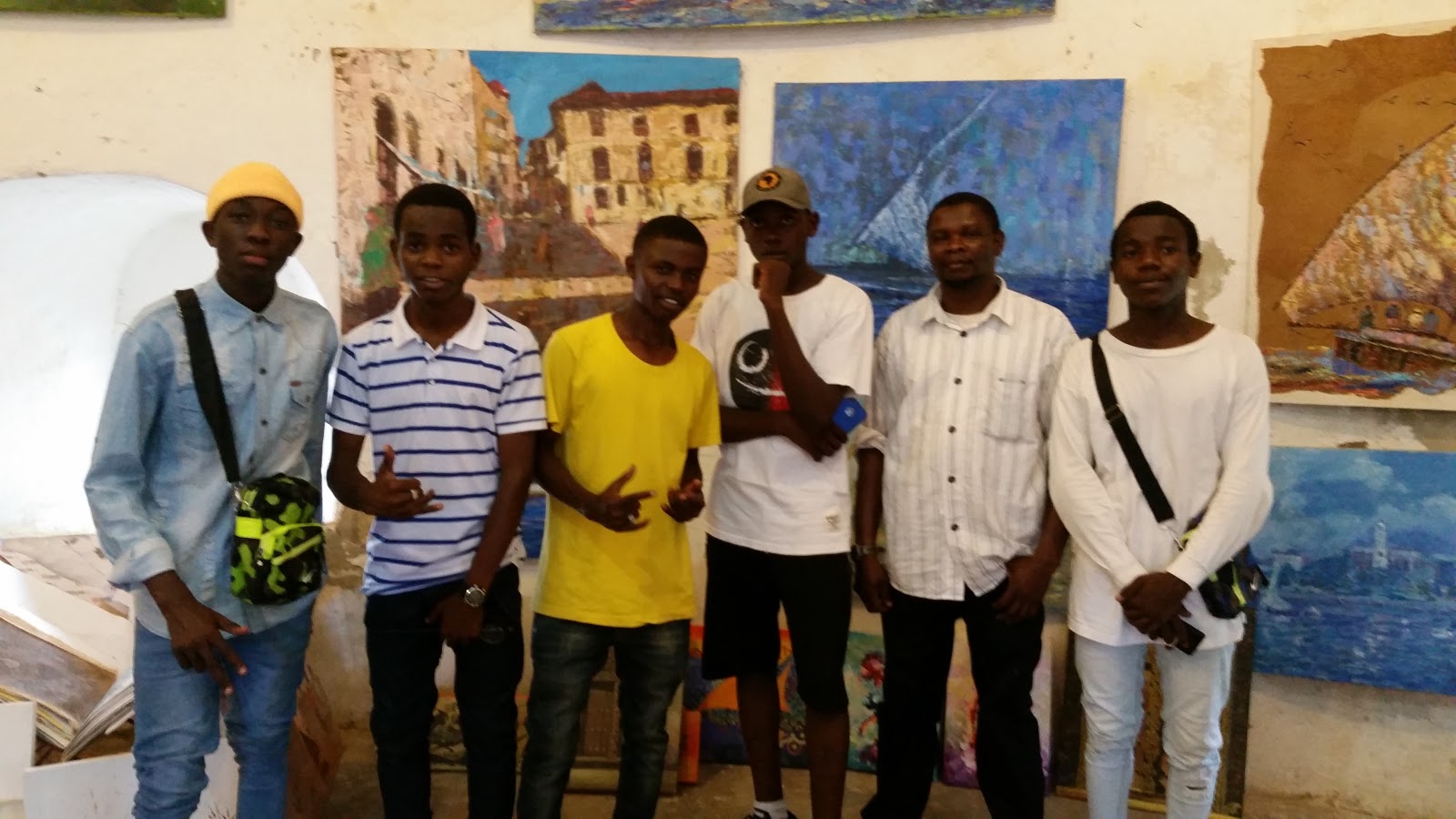
We walked through the courtyards and on the battlements. there were several art galleries, Colors of Zanzibar and Collective Art Gallery in the towers. Despite the artists obvious willingness to bargain over prices, we did not purchase anything. There were local spice and craft shops, and a good toilet.

We left the fort after about 1.5 hours and returned to the gardens. Engaged in a conversation with 4 teen age girls. They were very animated and questioned us about the US. They are learning English in school and asked us about our trip. 
Teenage girls

We were repeatedly approached by papaasi and after much haggling with one we agreed to a walking tour. Agreed to $20 for 2 hour tour.  What followed was a leisurely stroll through the Old/Stone Town area.  He started with a history lesson about the Old Fort and the Gardens. We then walked over to the House of Wonders, Beit al Ajaib. This was a state of the art building when it was built in 1883 as a ceremonial palace for the Sultan Barghash, and remains one of the largest buildings on the island. It is a perfect rectangle, topped by a large clock tower. It was built with marble floors, steel pillars and girders, was fitted with electric lighting and had an electric elevator. Hence the name House of Wonders. It served as a palace until 1911, then as a British colonial office for 50 years and the housed government and political party (there was only one political party so co-location was convenient) offices for 30 years until it was abandoned in the 1990s. It reopened as a museum in 2002, but the roof collapsed in 2016 and so it is not currently open to the public as it undergoes repairs. In front were two Portuguese cannons from the early 16th century.

A few hundred yards up the road we visited the Palace Museum. A large white building built close to the sea in the late 1890s it was originally called the Sultan's Palace, but was renamed the People's Palace after the 1964 Revolution. It became a museum in 1994. The exhibits included a lot of furniture, clothes and art from the sultans and British colonial period. There was a gigantic banyan tree 100 meters up the road. It was planted in 1911 and is known as The Big Tree. We then walked into the interior of the city and passed or visited old hotels, galleries, small businesses, restaurants, and mosques and churches. While the art in the galleries was locally produced, some of it seemed formalistic. 

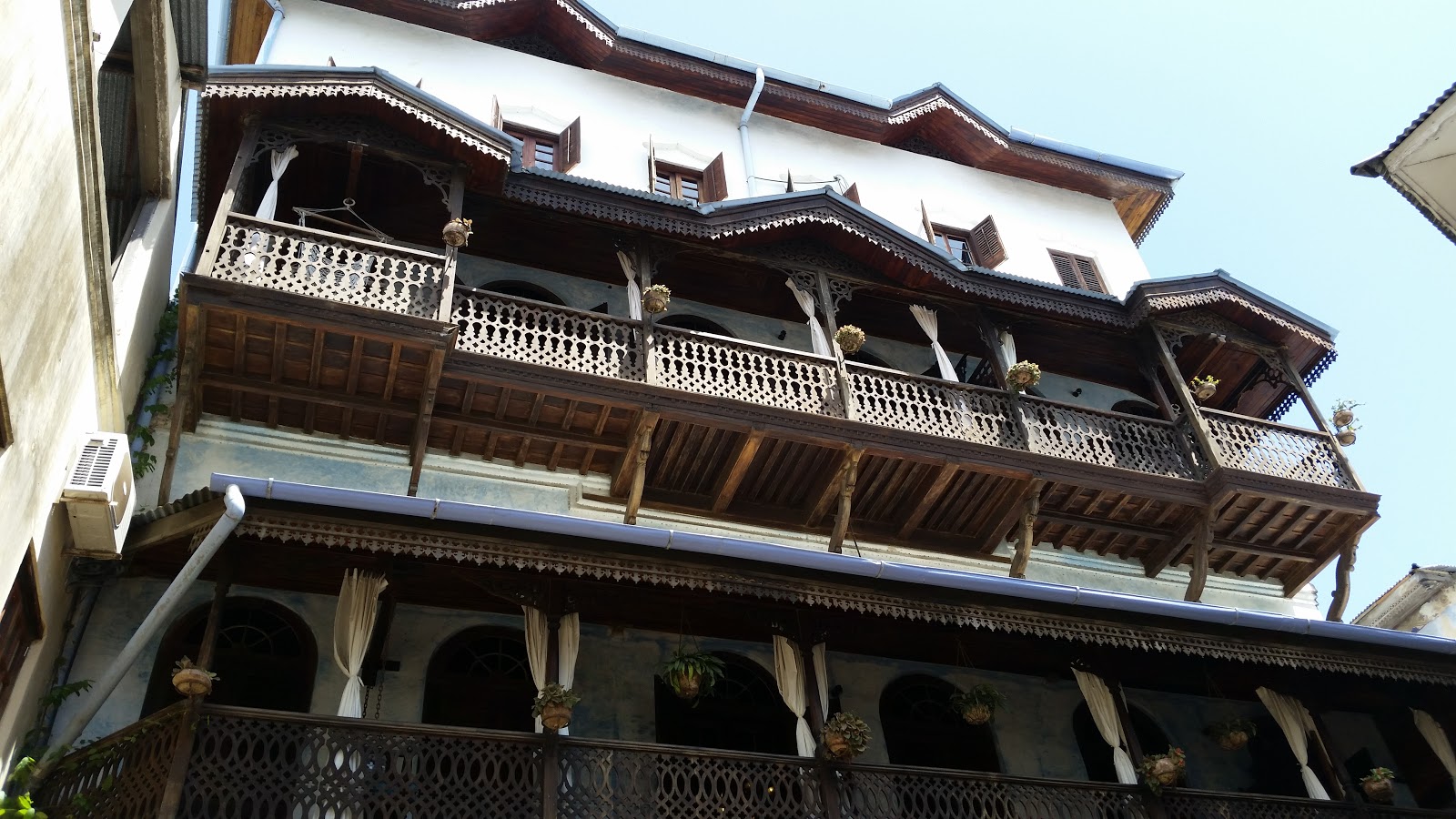
Most of the buildings we saw were built in the 19th century when Zanzibar was an important and affluent trading center. Many of the buildings were three or four stories and their stone construction consisted of locally mined coralline rock. It is a good construction material, but it is soft and easily eroded if not maintained. While virtually all of the buildings are still inhabited or used for commercial purposes, many are in a state of disrepair. However we saw some structures that were being restored to their original appearance through a UN and government program. (Reminded me of the restoration that is occurring in Old Havana.)   The buildings were predominately of two architectural styles, Arab, with plain outer walls and a large door which lead to an inner courtyard   (which we usually could not see), and Indian, with an open facade and large balconies decorated with ornate railings and balustrades designed to catch sea breezes and dispel the humidity. Very similar to what we saw in India, albeit much of that seemed to be based on the Mogul, Islam empire architecture. 


Many of the buildings had large wooden doors with elaborately carved frames and panels decorated with large brass studs, spikes and heavy locks. The studs and spikes were allegedly designed to prevent war elephant attacks. They are mostly decorative since while elephants were abundant on Zanzibar when Marco Polo passed through in the late 13th century, they were long extinct when  these structures were built in the 19th century. The greater the wealth and status of the owner, the more elaborate were the door carvings. Many of the doors had chains carved at the side which indicated that slaves were held in the house. We also saw, and sat on, many baraza benches. These are thick benches of solid stone, not very comfortable, built into the walls of the structures and also in the courtyards. They permitted Islamic men to receive visitors at or in their homes without compromising the privacy of the woman folk.
 Arab Style
 Indian style


At the Swahili House hotel we took the lift (added in 2015) to the roof top restaurant/bar for drinks and snacks on a baraza bench. Terrific 360 degree views of the Zanzibar Town, the Zanzibar Strait and the land outside of Stone Town. This was a 19th century Indian merchant's home that in 2008 was renovated into hotel. However it is not fancy and retains a local feel with a very calm environment.   

The Market at the east end of Stone Town along Creek Road  (the creek has been paved over) was built in 1904, and looks as if little has changed since then. (Viewing the photographs from the early days of the market in the market's museum confirmed that.) The market is essentially a long hall with traders inside and out selling their wares from small stalls or simply with their goods spread out on the ground. It was especially active today, since it was Friday. There were an amazing variety of goods available for purchase that included books, CDs, furniture, clothes, car parts, and even sewing machines. Of course there were also all manner of foods available. Speaking with some of the shoppers, mostly women who were very colorfully dressed it seemed as if they had come from many parts of the island.  

At the end of the Market was the seafood section. There were active auctions going on to sell batches of seafood and lots of filleting of the fish. Pretty big smells and lots of flys. 

I purchased more spices.

On the way back to the hotel we walked past the East African Slave exhibit. Did not go in at this time since we had used up our two hours. 

After the tour we visited several galleries and finally picked out three paintings. As usual there was a lot of bargaining and because the owner wanted cash I had an actual limit on my spending. We walked out with a very large cardboard tube as I wondered if I would be able to get that on our future flights and if so, without any damage to the paintings.

After shopping we returned to the roof top of the Swahili House to meet our daughter who was joining us for the weekend on Zanzibar . More  views, sun downers and snacks


and then we walked through town to the Monsoon restaurant. This serves Mediterranean and Zanzabari food. You doff your shoes upon entering and sit on rugs and cushions, I needed a lot of the latter, and essentially sit on the floor, Kasbah style. There was live taarab music and after dinner we spoke with the musicians for a while. The food was good and the price was a great value. However after dinner I had to return to the back machine for another infusion of local cash.

At the hotel we had some dessert on the beach side patio followed by an evening swim in the pool

Overall Stone town is a very vibrant and charming place. Unlike Dubrovnik, from which most of the residents have moved and is essentially now a giant outdoor museum, Stone town is a living community where the residents live, work and play, along with the many tourists.